Fault tolerance

paris_thunderstorm_1902

El Golem

Si (como afirma el griego en el Cratilo)
el nombre es arquetipo de la cosa
en las letras de ‘rosa’ está la rosa
y todo el Nilo en la palabra ‘Nilo’.

Y, hecho de consonantes y vocales,
habrá un terrible Nombre, que la esencia
cifre de Dios y que la Omnipotencia
guarde en letras y sí­labas cabales.

Adán y las estrellas lo supieron
en el Jardí­n. La herrumbre del pecado
(dicen los cabalistas) lo ha borrado
y las generaciones lo perdieron.

Los artificios y el candor del hombre
no tienen fin. Sabemos que hubo un dí­a
en que el pueblo de Dios buscaba el Nombre
en las vigilias de la juderí­a.

No a la manera de otras que una vaga
sombra insinúan en la vaga historia,
aún está verde y viva la memoria
de Judá León, que era rabino en Praga.

Sediento de saber lo que Dios sabe,
Judá León se dió a permutaciones
de letras y a complejas variaciones
y al fin pronunció el Nombre que es la Clave,

la Puerta, el Eco, el Huésped y el Palacio,
sobre un muí±eco que con torpes manos
labró, para enseí±arle los arcanos
de las Letras, del Tiempo y del Espacio.

El simulacro alzó los soí±olientos
párpados y vio formas y colores
que no entendió, perdidos en rumores
y ensayó temerosos movimientos.

Gradualmente se vio (como nosotros)
aprisionado en esta red sonora
de Antes, Después, Ayer, Mientras, Ahora,
Derecha, Izquierda, Yo, Tú, Aquellos, Otros.

(El cabalista que ofició de numen
a la vasta criatura apodó Golem;
estas verdades las refiere Scholem
en un docto lugar de su volumen.)

El rabí­ le explicaba el universo
“esto es mi pie; esto el tuyo, esto la soga.”
y logró, al cabo de aí±os, que el perverso
barriera bien o mal la sinagoga.

Tal vez hubo un error en la grafí­a
o en la articulación del Sacro Nombre;
a pesar de tan alta hechicerí­a,
no aprendió a hablar el aprendiz de hombre.

Sus ojos, menos de hombre que de perro
y harto menos de perro que de cosa,
seguí­an al rabí­ por la dudosa
penumbra de las piezas del encierro.

Algo anormal y tosco hubo en el Golem,
ya que a su paso el gato del rabino
se escondí­a. (Ese gato no está en Scholem
pero, a través del tiempo, lo adivino.)

Elevando a su Dios manos filiales,
las devociones de su Dios copiaba
o, estúpido y sonriente, se ahuecaba
en cóncavas zalemas orientales.

El rabí­ lo miraba con ternura
y con algún horror. ‘í¿Cómo’ (se dijo)
‘pude engendrar este penoso hijo
y la inacción dejé, que es la cordura?’

‘í¿Por qué di en agregar a la infinita
serie un sí­mbolo más? í¿Por qué a la vana
madeja que en lo eterno se devana,
di otra causa, otro efecto y otra cuita?’

En la hora de angustia y de luz vaga,
en su Golem los ojos detení­a.
í¿Quién nos dirá las cosas que sentí­a
Dios, al mirar a su rabino en Praga?

(Jorge Luis Borges, 1958)

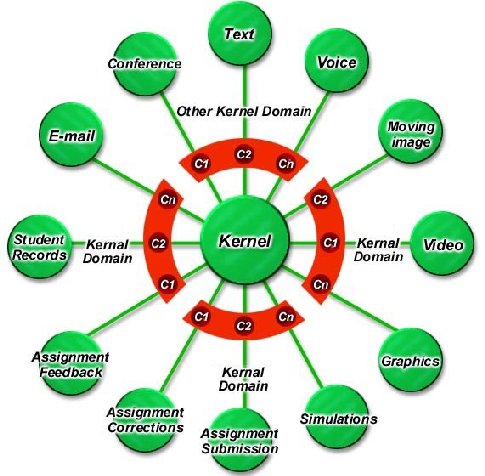
kernel

In Jewish tradition, the golem is most widely known as an artificial creature created by magic, often to serve its creator. The word “golem” appears only once in the Bible (Psalms139:16). In Hebrew, “golem” stands for “shapeless mass.” The Talmud uses the word as “unformed” or “imperfect” and according to Talmudic legend, Adam is called “golem,” meaning “body without a soul” (Sanhedrin 38b) for the first 12 hours of his existence. The golem appears in other places in the Talmud as well. One legend says the prophet Jeremiah made a golem However, some mystics believe the creation of a golem has symbolic meaning only, like a spiritual experience following a religious rite.

The Sefer Yezirah (“Book of Creation”), often referred to as a guide to magical usage by some Western European Jews in the Middle Ages, contains instructions on how to make a golem. Several rabbis, in their commentaries on Sefer Yezirah have come up with different understandings of the directions on how to make a golem. Most versions include shaping the golem into a figure resembling a human being and using God’s name to bring him to life, since God is the ultimate creator of life..

According to one story, to make a golem come alive, one would shape it out of soil, and then walk or dance around it saying combination of letters from the alphabet and the secret name of God. To “kill” the golem, its creators would walk in the opposite direction saying and making the order of the words backwards.

Other sources say once the golem had been physically made one needed to write the letters aleph, mem, tav, which is emet and means “truth,” on the golem’s forehead and the golem would come alive. Erase the aleph and you are left with mem and tav, which is met, meaning “death.”

Another way to bring a golem to life was to write God’s name on parchment and stick it on the golem’s arm or in his mouth. One would remove it to stop the golem.

Often in Ashkenazi Hasidic lore, the golem would come to life and serve his creators by doing tasks assigned to him. The most well-known story of the golem is connected to Rabbi Judah Loew ben Bezalel, the Maharal of Prague (1513-1609). It was said that he created a golem out of clay to protect the Jewish community from Blood Libel and to help out doing physical labor, since golems are very strong. Another version says it was close to Easter, in the spring of 1580 and a Jew-hating priest was trying to incite the Christians against the Jews. So the golem protected the community during the Easter season. Both versions recall the golem running amok and threatening innocent lives, so Rabbi Loew removed the Divine Name, rendering the golem lifeless. A separate account has the golem going mad and running away. Several sources attribute the story to Rabbi Elijah of Chelm, saying Rabbi Loew, one of the most outstanding Jewish scholars of the sixteenth century who wrote numerous books on Jewish law, philosophy, and morality, would have actually opposed the creation of a golem. (Source)


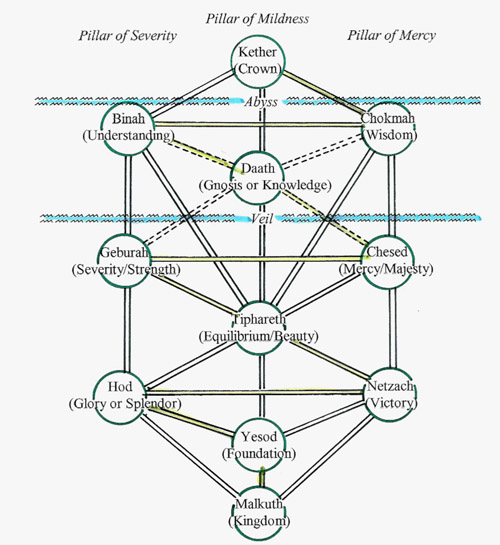
cabbalah

Kernel

Etymology: From Old English cyrnel, dimunitive of corn, seed
Pronunciation: * IPA: /Ã?Ë?kÃ?Å?ínÃ?â?¢l/ (UK) or /Ã?Ë?kínÃ?â?¢l/ (US)
1. The smallest, most basic piece of an object.
2. The very core, or center, of a larger system, upon which everything else is built.
3. (computing) The central part of many computer operating systems which manages the system’s resources and the communication between hardware and software components
4. A single seed, usually of corn.
5. The stone of certain fruits.
6. (mathematics) those elements, in the domain of a function, which the function maps to zero

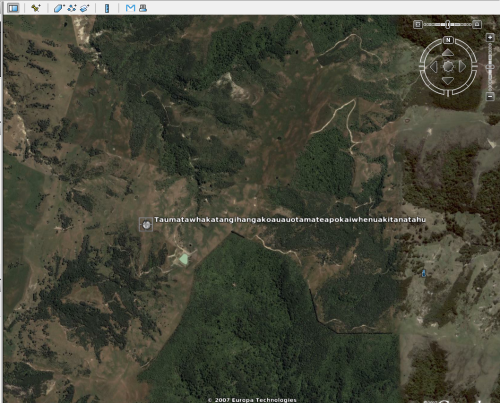
Taumatawhakatangihangakoauauotamateaturipukakapikimaungahoronukupokaiwhenuakitanatahu

taumataw

Taumatawhakatangihangakoauauotamateapokaiwhenuakitanatahu, ou Taumatawhakatangihangakoauauotamateaturipukakapikimaungahoronukupokaiwhenuakitanatahu é o nome maori para uma colina de 305 metros de altura próxima a Porangahau, sul de Waipukurau na região meridional da Baí­a de Hawke, Nova Zelândia. O nome é freqüentemente abreviado para Taumata pelos locais, para facilitar a conversação. O nome é í s vezes citado como sendo a palavra mais longa em inglês.

taumata
plaquinha indicativa

O nome escrito na placa que assinala a colina é Taumatawhakatangihangakoauauotamateaturipukakapikimaungahoronukupokaiwhenuakitanatahu, o que, numa tradução literal seria algo como A testa [ou cume] da colina [ou lugar], onde Tamatea, o homem de joelhos grandes, que desceu, escalou e engoliu montanhas, [para viajar pela terra], que é conhecido como comedor de terra, tocou flauta nasal para sua amada. Com 85 letras, é um dos maiores nomes de lugares do mundo.

inspirado em bababadalgharaghtakamminarronnkonnbronntonnerronntuonnthunntrovarrhounawnskawntoohoohoordenenthurnukwhikipedia

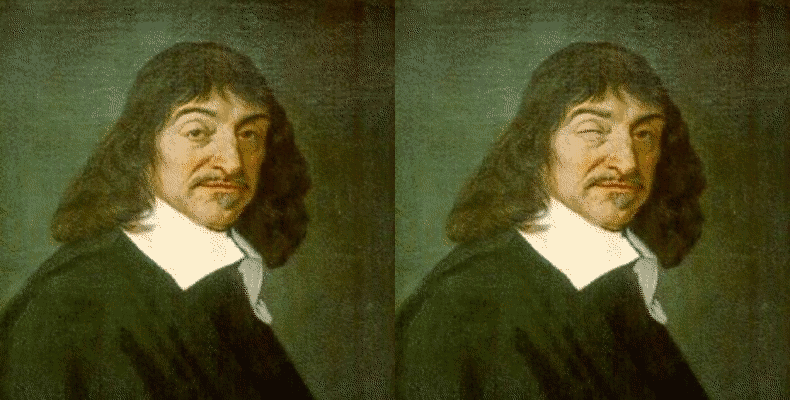
Cogito não Pára

cogito

Não deverí­amos ter expectativa alguma do que fazemos, o que fazemos não é bom nem ruim, o que fazemos é nada. Os acontecimentos somente fazem parte de um coeficiente infinito: 0=0, pura redundância. Cúmplices de uma farsa, nossa lógica não é limpa, somos exorcizados a golpes inautênticos gerados pela cultura econômica dos excessos. Toda nova informação é formulada por uma expectativa frustrada, absoluta e que aponta para um único sentido/abismo.

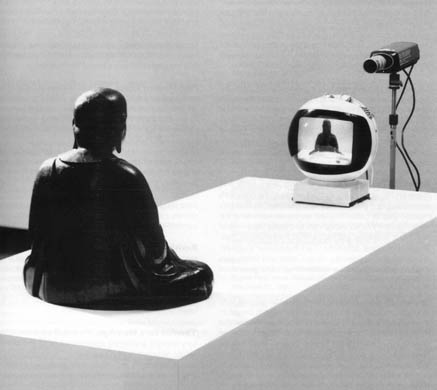
paik-buda
paik-buda
sala kernel programação

Desvio ou catástrofe? Delirium tremens. Ser o tormento dos próprios pensamentos, perturbação da nossa própria ordem. O desafio como ruí­do como desafio.
CONFUNDE A TI MESMO

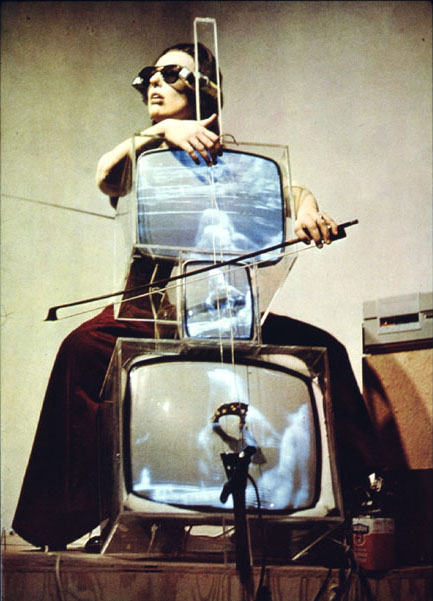
moorman-paik
paik-violoncelista
It’s it! what is It?
CONFUNDORIENTA

Jean Baudrillard, o fotógrafo (27/07/1929 – 06/03/2007)

Entrevista com Jean Baudrillard – 1999

Sheila Leirner – Você está preparando muitas coisas ao mesmo tempo: um grande livro que vai ter a mesma importância de “L’Échange Symbolique et la Mort” de 1976, ou seja, vai amarrar toda a sua produção de lá para cá como um marco; traduz Hí¶lderlin; continua um último “Cool Memories” que começou em 1995 e termina no ano 2000. Qual é o lugar da fotografia no meio de toda essa produção?

Jean Baudrillard.
– Tudo o que eu escrevi sobre a fotografia, a “troca impossí­vel”, o ví­nculo com a imagem e o virtual, etc, juntei em vários lugares, como no “O Paroxista Indiferente” e em outros livros, como os de entrevistas”¦

S.L.
– Desde 1991, essa deve ser a quarta conversa que nós fazemos para a mí­dia brasileira. Hoje, porém, nada de paroxista indiferente, guerra do Golfo, ilusão do fim, crimes perfeitos, complô da arte, confusões com a extrema direita. Gostaria que falássemos sobretudo sobre fotografia, sobre a sua fotografia que poucos conhecem. Há quanto tempo você fotografa?

J.B. – Oh!la!la! Já conversamos tudo isso? (Risadas)

Está bem, minha fotografia já tem uma década, mas ela se cristalizou melhor nos últimos dois ou três anos embora seja uma atividade paralela, pois os textos ficam sempre como ponto de fixação. Com a minha escritura eu faço uma coisa predestinada. Com a foto não. Quer dizer, pensando bem, até que sim”¦ Eu não poderia fazer pintura, escrever romances, rodar filmes. Antes eu exerci uma prática de polí­tica universitária e agora exerço algo imaterial, que é a prática da imagem”¦

S.L.
– Imaterial ? Você diz que fotografar não é tomar o mundo como objeto, mas transformá-lo em objeto !

J.B. – Sim. Quero dizer imaterial, porém não para mim. A minha relação é com o objeto, as situações, a luz e a matéria. Trata-se de uma ligação que não é desencarnada, de certa forma é até carnal. A foto parte do mesmo núcleo que a escritura. A matriz é idêntica. No lugar de idéias, imagens.

S.L.
– Antes você não pensava assim. Lembro-me que há alguns anos dizia não estabelecer nenhuma relação entre escrever e fotografar. E que se existia algo em comum era seguir essa coisa que está do outro lado do sujeito, perto do objeto, essa coisa irredutí­vel, que tem uma ausência própria. Você não procurava captar a realidade dos objetos, não queria interpretá-los, decifrá-los”¦

J.B.
– É verdade. Contudo, o que eu busco agora é tomar os objetos em sua literalidade, antes que comecem a “significar”. É um pouco como a linguagem poética que consegue existir antes de adquirir um sentido. Quando você escreve teoria, é difí­cil chegar lá pois o discurso tem sempre um significado. Mas í s vezes você entra numa linguagem quase poética, mesmo na teoria”¦

S.L.
– A fotografia não seria para você uma espécie de “prova prática”, uma demonstração de tudo aquilo que você propõe em sua teoria?

J.B. – Não ! Isso não ! Demonstração não ! Não tenho nada a demonstrar.

S.L.
– Uma prática dessa teoria ?

J.B. – Uma prática sim. Mas ela não é radical, pois se fosse não deveria nem mesmo ser estética. Eu próprio lastimo, mas acho as minhas fotos belas demais ! (Risadas). Tanto é que as melhores não são belas, as “melhores são as piores”, como se diz. Porém, a meu ver, ali é praticamente impossí­vel chegar a alguma coisa que seja tão radical quanto as idéias que estão na cultura. O radicalismo da fotografia não está na idéia, está na literalidade. Nela, trata-se de encontrar um puro modo de aparição, enquanto que as idéias e a escritura constituem um modo de composição.

S.L. – Se na sua fotografia existe a tentativa de encontrar um puro modo de aparição, a escolha do sujeito não deveria importar. Porém, se “os objetos esperam que você os tome”, “que você os viole ‘sur place'”, como você diz, então porque só os objetos belos pedem essa violação? Porque as suas fotos nunca saem feias?

J.B.
– Para mim não tem belo ou feio, mas eu também não vou pegar os objetos só porque eles são feios. Essa é a estética atual da feiúra, e eu não vou cair nela”¦ O que existe, e isso é importante, preste atenção, é a conjunção entre os objetos e uma finalidade técnica. Chegar í  que a captação se faça quase como uma escrita automática. Agora, há uma escolha dos objetos, é claro”¦

S.L. – Uma escolha estética”¦

J.B. – Sim. Senão eu ficaria só fotografando aquela janela em frente da minha.

S.L.
– Então existe um desejo seu. Não são os objetos que escolhem você, não são eles ” o sonham”, não “é o mundo que lhe reflete”, como você diz.

J.B. – Na verdade essa não é realmente uma escolha estética, é algo baseado na singularidade da imagem, da luz. Eu não sou a favor de fotografar tudo e qualquer coisa. Hoje em dia com a técnica de que se dispõe pode-se fazer ótimas fotos com o que se quiser. Eu não possuo talento técnico, procuro efetivamente algo de singular, um pouco como o “punctum” que Roland Barthes descreve.

S.L.
– O “punctum” ou pontuação é a palavra que designa uma picada, uma marca, algo que vem ferir ou pungir o olhar. Os objetos que você escolhe talvez possuam para você esse “punctum”, mas o resultado de suas fotos é quase sempre indefectivelmente plástico.

J.B. – Você pode pegar objetos que já são estetizados, que são remarcáveis por sua própria qualidade estética. Ou você pode lhes impor uma estética, o que fazem hoje os fotógrafos. No meu caso, trata-se de escolher algo excepcional, porém não por meio de uma forma estética. É o objeto que me acena.

S.L. – Será que você fala de Barthes nesse ensaio “A Câmara Clara”, porque ele distingue a fotografia da arte fotográfica; e você, no fundo, rejeita a sua fotografia como arte ?

J.B.
– Exatamente. Existem grandes fotógrafos, belas fotos que fazem parte da imensa maioria da arte fotográfica. Aqui não se trata de arte. Eu não sou um artista.

S.L.
– Sempre a mesma história !

J.B.
– Então não vale a pena repetir (Risadas).

S.L. – Você sempre diz que não é artista, mas toma os objetos em sua literalidade, em seu “punctum” que você descobre com a sua pura sensibilidade, e, como os poetas, tenta fazê-los existir antes que adquiram um sentido. Você sabe bem que a arte não é apenas uma questão de estética e a arte conceitual está aí­ para provar isso. Pois que só pensa pelos contrários, talvez você seja um artista apesar de você, não?

J.B.
– As vezes essa é a melhor maneira de sê-lo (Risadas)! Mas, veja bem, como você diz, o livro de Barthes não é um livro de fotógrafo. Pode ser visto como um livro metafí­sico, de teoria, de um pensador. A foto o interessa tanto quanto o texto. Que prazer e paixão pode-se ter por uma imagem, e não apenas o prazer estético. Não é nem mesmo do ní­vel do julgamento estético, pois o “punctum” está além dele, é uma forma de sedução instantânea. É um malentendido falar de sujeito e objeto nessas histórias. Mas é preciso pensar também que é um mito que nós possamos estar além do julgamento. Evidentemente existe sempre o julgamento, como existe sempre o discurso, como sempre existe uma escolha, uma afinidade”¦ é como nas relações pessoais. Mas não sou um artista. A minha jogada é muito mais da ordem do fatal do que do conceitual ou do estético.

S.L. – Depois a coisa pode entrar na historia da arte”¦

J.B. – Depois a coisa pode entrar na historia da arte, mas é uma outra existência. O “punctum” é uma matriz que escapa í  toda categoria institucional enquanto ele existe, depois ele cai no mundo, na mundaneidade estética, e ninguém mais é responsável. Mas eu acho que existe um verdadeiro segredo onde as coisas aparecem e se produzem sozinhas, possuem uma forma de poder e de ilusão. A questão que atravessa o livro de Barthes é “onde está a realidade?”. O que você busca, por meio da imagem, é por em jogo essa realidade e verificar, paradoxalmente, que o mundo não é real. Há uma ilusão fundamental que é preciso conseguir captar. Depois, bem, a realidade existe também. Ela existe mas, sou agnóstico, não acredito nela.

S.L.
– Porque não ?

J.B. – Se a realidade existe a gente não precisa acreditar nela. Pois se acreditarmos, ela torna-se um objeto de credo. E se for um credo, então deixa de ser uma realidade objetiva. Se ela é uma realidade objetiva, não precisa que nós acreditemos nela pois é objetiva. Porém, se você acreditar nela, ao contrário, você não a estará honrando como uma objetividade e ela passa a não existir mais. É como Deus, você entende? Se você começa a acreditar nele, ele não existe mais enquanto Deus. Torna-se um objeto de credo. E isso não O honra muito, pois na sua Existência Ele não tem nenhuma necessidade que as pessoas acreditem Nele. A única chance de a realidade existir é nós não acreditarmos nela”¦

S.L. – O fato é que vivemos sob um sistema de valores realistas. Veja o caso de Henri Cartier-Bresson, por exemplo. Há alguns anos, na conversa que tivemos para o Caderno 2, ele declarou que a fotografia é um pequeno “métier” e que o seu processo não o interessa, pois o que lhe importa é a vida e o meio imediato de transcrevê-la. O que você pensa disso?

J.B. – Eu só o encontrei umas duas ou três vezes. Ele tem consciência do seu gênio? É ansioso?

S.L. – Ele é terrivelmente mau-humorado. Não tem consciência disso como fotógrafo, mas tem ansiedade e pensa que possui gênio como pintor e desenhista, que é onde não possui gênio nenhum.

J.B.
– (Risadas) Cartier-Bresson é uma lenda, um mito. Mas a sua fotografia não é a que mais me toca. É uma espécie de arte poético-realista de uma certa época”¦ uma bonita época que aliás teve o seu apogeu no cinema, mas não sei”¦ essa foto não é exatamente especí­fica, ela é mais ou menos bela, mais ou menos bem sucedida, anedótica, descreve uma sociedade. É humanista, conta uma história, faz uma narrativa um pouco retrô. E parte do seu sucesso enorme é que se trata de um retrô.

S.L. – É que nós vivemos em termos de nostalgia estética”¦

J.B.
– É. Mas estamos cheios de ver isso! Estamos cheios de ver esses dois meninos segurando esses dois litros de vinho, essas “obras-primas” ! (Risadas) Que, a meu ver não são nada grandiosas.

S.L.
– Você pensa a mesma coisa de Sebastião Salgado?

J.B. – Não. Ele é admirável se quisermos, mas suscita o problema do voyeurismo sóciopolí­tico. A sua fotografia trata do humanismo da miserabilidade. Tudo isso me provoca um problema quase moral que não tenho vontade de resolver. É a foto-testemunho sobre a qual escrevi também algumas páginas. E aqui igualmente é preciso voltar a Barthes, pois o testemunho é o fim da fotografia. Ele inscreve uma idéia, uma verdade, ele não fotografa o que é, mas o que não deveria ser. Isso é uma posição moral de denegação. Se esta é uma foto moralizante, em relação í  própria imagem ela é um contra-senso. Seria preciso que a imagem pudesse estar lá por sua especificidade e não curto-circuitada por uma idéia moralista, histórica”¦

S.L. – É uma imagem narrativa de quem, ao contrário de você, não é nada agnóstico com relação í  realidade.

J.B. – É uma imagem usurpada. Há um abuso de imagem. Ela serve para exprimir algo, então é avassalada, não é imagem enquanto tal. Pode ser bela, mas é uma mistura de verdade, testemunho, moral e estética. Isso são valores que não me interessam. É a forma que conta. De todo modo, as fotos de Salgado são admiráveis pois tem uma bela composição, são esteticamente excelentes. São mundanas, no sentido em que a miséria do mundo também é mundana. Não devemos falar isso de forma demasiadamente brutal, senão nos tornamos cí­nicos, mas é preciso dizê-lo”¦

S.L. – Voltando a Cartier-Bresson, ele diz também que pode-se fazer qualquer coisa com uma máquina fotográfica, que só é difí­cil descascar uma batata com ela”¦

J.B. – (Risadas) Ele diz isso? Ele é engraçado ! Isso é verdade.

S.L. – Ele afirma ainda que todos são fotógrafos, que há tantos fotógrafos no mundo quanto aparelhos. Você concorda?

J.B. – Sim. Dá para ir ainda mais longe: dos livros sobre fotografia, há também o de Wilheim Flusser, nosso falecido amigo em comum que você convidou para as suas bienais. Flusser é bem mais radical que Cartier-Bresson. Ele diz que o fotógrafo não é senão o operador das possibilidades técnicas da máquina. É um pouco a reedição da fórmula Mac Luhan, “o meio é a mensagem”. Essa teoria é justa.

S.L. – Pensando bem, não ficou na lembrança muita coisa importante escrita sobre a fotografia. Tem você, Barthes, Susan Sontag, Flusser”¦

J.B. – É verdade. Mas você sabia que existe um texto fundamental de Italo Calvino sobre a fotografia que ninguém conhece, que se chama “A aventura de um fotógrafo” e que está num livro que se chama “Aventuras” ? Extraordinário ! Nem é preciso mais escrever sobre a fotografia pois tudo está lá. São dez páginas onde ele conta a história de alguém em seu processo de se tornar um fotógrafo. Esse personagem fotografa obsessivamente a sua amante em todas as posições, ela se cansa, o abandona, e ele começa a fotografar todos os objetos que estão lá no mesmo espaço. Contenta-se em fotografar eternamente tudo, e a história termina num delí­rio”¦

S.L. – Esse paroxismo o seduz ?

J.B. – É verdade que se estivermos possuí­dos pelo demônio da fotografia, a coisa termina num delí­rio, pois uma máquina técnica como essa é delirante em si, lhe dá todas as possibilidades e abre para a loucura!

S.L. – Essa loucura não está relacionada também com o tempo ? Segundo certos fotógrafos, mesmo os mais acadêmicos, existe uma angústia muito grande no delí­rio temporal. Ali, o presente concreto que pede para ser captado acontece numa fração de segundo, o que é desagradável e maravilhoso simultaneamente.

J.B.
– É essa a diferença entre a fotografia e uma atividade estética como o desenho, por exemplo. O “punctum” não está apenas na idéia, está também no tempo. Quer dizer, existe um momento irreversí­vel, imediatamente terminado e os fotógrafos têm razão.

S.L. – Muito embora você esteja no sentido inverso dos fotógrafos acadêmicos, que partem desse “instantâneo”, que é o “punctum” no tempo, para fazer uma obra pictórica e linear, que é oposta a ele”¦

J.B. – Sem dúvida. Para mim a fotografia não acontece senão sob a base da desaparição da vontade estética, apenas como objeto puro”¦

S.L. – Aí­ entra a questão da ficção. Uma vez que você toma o “objeto puro” como personagem “em via de aparição” num mundo em cuja realidade não acredita, você está criando uma ficção para que ele exista. Um cenário artificial, composto por meio da fotografia, para abrigar a sua existência. Isso me remete ao trabalho de fotógrafos como Miguel Rio Branco ou Cindy Sherman, que, sem serem acadêmicos, certamente partem da estética e da subjetividade para chegar í  narração pictórica, í s vezes barroca, dessa realidade.

J.B. – Sim, mas isso é performance ! Nesse momento há um ciclo de atividades que é a construção de coisas e em seguida a representação delas. Eu não vejo onde está o momento original da foto lá dentro. Não é regra geral, mas se a foto consegue apagar o trabalho, fazer uma elipse sobre a construção e a demonstração do objeto, então ela volta a ser fotografia pura e simples. Eu não faço trucagem. Sempre existe um mergulho, uma escolha de luz, uma mis-en-scí¨ne subjetiva, mas eu os separo daquilo que vem de fora, eu mesmo venho de fora”¦ E acontece um encontro entre nós dois. Ao contrário de Rio Branco, não há nada de barroco no meu trabalho.

S.L. – Como é que você trabalha ?

J.B. – O meu método não tem nada a ver com o desses ficcionistas, mas também não tem relação com o de Cartier-Bresson. Eu tiro uma quantidade enorme de fotos e depois jogo fora o que não gosto. Quando fotografo, não controlo a situação e não quero controlá-la. Aí­ é um exercí­cio completamente diferente da escritura. Gosto desse sentido aleatório da fotografia. Mas o importante é saber fazer a elipse. Toda a força da linguagem está nela.

S.L. – E se você tivesse que escolher um fotógrafo com quem sentisse uma afinidade ?

J.B. – Eu escolheria Luigi Ghirri ou Wim Wenders. Temos em comum não fotografar seres humanos. São universos hiper-realistas interessantes, mesmo que tenham se tornado um pouco estereotipados.

S.L. – Você não tem medo de também criar estereótipos com as suas fotos?

J.B.
– Não! Não! Não vejo nada de comum entre minhas fotos. Estão todas numa espécie de desordem de cenas, objetos e ninguém jamais conseguiu encontrar um tema. Isso me deixa muito feliz! Não há personagens, rostos, sociologia, história, nada. Fiz a elipse máxima da coisa”¦ a ponto de me perguntar onde está a realidade lá dentro.

S.L. – Existe uma imagem difí­cil de esquecer que você inventou para a proliferação das obras de arte. Você disse que elas crescem como cogumelos cobrindo o mundo. Não fica assustado em pensar que as suas fotos e os seus textos se proliferam também?

J.B. – (Risadas) Sim, sim. Isso me incomoda. É porisso que eu pratico a “arte da desaparição”, ou seja, a arte de dosar homeopaticamente a existência dos objetos dos quais eliminei as minhas próprias pegadas. Quer dizer, você dá ao mundo objetos sublimes no sentido literal, que não pretendem nada, despojados ao máximo, e que são objetos de aparição/desaparição. Não são produzidos, construí­dos, não pertencem í s instituições em termos de significação, sentido, etc. Pratico uma arte de ilusionista, não sou produtor, criador ou artista. Tudo isso é uma superestrutura completamente paranóica. Por meio da elipse eu reduzo a realidade atravancada a tal ponto que chego í  forma mí­nima. É a forma mais intensa, pois não tem uma existência representativa.

S.L. – Em que outros lugares encontramos formas parecidas a essas procuradas por você?

J.B. – Na música, por exemplo. Existem músicas que se dissipam. Elas não se impõem, elas se resolvem. Tudo se passa em termos de uma resolução perfeita. Não há resí­duos, como os que encontramos nesse mundo do deteriorável. A música é um objeto que possui a magia de aparecer e desaparecer ao mesmo tempo. É preciso essas duas forças reversí­veis, senão a sua obra fica como uma coisa produzida que atravanca a paisagem e se acumula em estoque. E há equivalentes desses objetos, vazios e ao mesmo tempo presentes, no texto ou na imagem.

S.L. – Sabemos o desgaste que sofreu a palavra revolucionário. No entanto, para terminar, se entendermos por ela a capacidade de mudar o sistema de valores, poderí­amos dizer ainda que as suas estratégias no texto e na imagem são revolucionárias ?

J.B. – Eu não tento mudar o sistema de valores. O que eu pretendo é ficar fora do jogo e inventar uma outra regra para ele. Isso não é revolução, pois infelizmente não existe mais uma vontade polí­tica. Eu me coloco num universo paralelo, onde não há contradição violenta contra o sistema dominante, onde, mesmo que a minha posição o coloque em questão, não há nenhuma chance de revolucioná-lo na sua lógica. Estou na singularidade.

Ã?â?Ã?â??Ã?â?¢Ã?¨Ã?â? hi-j-ra ÇÃ?¬Ã?±é

The Digital Artisans Manifesto by Richard Barbrook and Pit Schultz

European Digital Artisans Network 1st May 1997

::::::::::::::::::::::::::::::::::::::::::::::::::::::::::::

mecca-cola.jpg

The Digital Artisans Manifesto

Making The Future

1. We are the digital artisans. We celebrate the Promethean power of our labour and imagination to shape the virtual world. By hacking, coding, designing and mixing, we build the wired future through our own efforts and inventiveness.

2. We are not the passive victims of uncontrollable market forces and technological changes. Without our daily work, there would be no goods or services to trade. Without our animating presence, information technologies would just be inert metal, plastic and silicon. Nothing can happen inside cyberspace without our creative labour. We are the only subjects of history.

3. The emergence of the Net signifies neither the final triumph of economic alienation nor the replacement of humanity by machines. On the contrary, the information revolution is the latest stage in the emancipatory project of modernity. History is nothing but the development of human freedom.

4. We will shape the new information technologies in our own interests. Although they were originally developed to reinforce hierarchical power, the full potential of the Net and computing can only be realised through our autonomous and creative labour. We will transform the machines of domination into the technologies of liberation.

5. We will contribute to the process of democratic emancipation. As digital artisans, we will come together to promote the development of our trade. As citizens, we will participate within republican politics. As Europeans, we will help to break down national and ethnic barriers both inside and outside of our continent.

The Present Moment

6. Freedom today is now often just the choice between commodities rather the ability to determine our own lives. Over the past two hundred years, the factory system has dramatically increased our material wealth at the cost of removing all meaningful participation in work. Even poorer members of European societies can now live better than the kings and aristocrats of earlier times. However the joys of consumerism are usually constrained by the boredom of most jobs.

7. Since 1968, the desire for increased monetary rewards has increasingly been supplemented by demands for increased autonomy at work. In the European Union and elsewhere, neo-liberals have tried to recuperate these aspirations through their policies of marketisation and privatisation. If we are talented workers in the ‘cutting-edge’ industries like hypermedia and computing, we are promised the possibility of becoming hip and rich entrepreneurs by the Californian ideologues. They want to recruit us as members of the ‘virtual class’ which seeks to dominate the hypermedia and computing industries.

8. Yet these neo-liberal panaceas provide no real solutions. Free market policies don’t just brutalise our societies and ignore environmental degradation. Above all, they cannot remove alienation within the workplace. Under neo- liberalism, individuals are only allowed to exercise their own autonomy in deal-making rather than through making things. We cannot express ourselves directly by constructing useful and beautiful virtual artifacts.

9. For those of us who want to be truly creative in hypermedia and computing, the only practical solution is to become digital artisans. The rapid spread of personal computing and now the Net are the technological expressions of this desire for autonomous work. Escaping from the petty controls of the shopfloor and the office, we can rediscover the individual independence enjoyed by craftspeople during proto-industrialism. We rejoice in the privilege of becoming digital artisans.

10. We create virtual artifacts for money and for fun. We work both in the money-commodity economy and in the gift economy of the Net. When we take a contract, we are happy to earn enough to pay for our necessities and luxuries through our labours as digital artisans. At the same time, we also enjoy exercising our abilities for our own amusement and for the wider community. Whether working for money or for fun, we always take pride in our craft skills. We take pleasure in pushing the cultural and technical limits as far forward as possible. We are the pioneers of the modern.

11. The revival of artisanship is not a return to a low-tech and impoverished past. Skilled workers are best able to assert their autonomy precisely within the most technologically advanced industries. The new artisans are better educated and can earn much more money. In earlier stages of modernity, factory labourers symbolised of the promise of industrialism. Today, as digital artisans, we now express the emancipatory potential of the information age. We are the promise of history.

12. We not only admire the individualism of our artisan forebears, but also we will learn from their sociability. We are not petit-bourgeois egoists. We live within the highly collective institutions of the market and the state. For many people, autonomy over their working lives has often also involved accepting the insecurity of short- term contracts and the withdrawal of welfare provisions. We can only mitigate these problems through our own collective action. As digital artisans, we need to come together to promote our common interests.

13. We believe that digital artisans within this continent now need to form their own craft organisation. In early modernity, artisans enhanced their individual autonomy by organising themselves into trade associations. We proclaim that the collective expression of our trade will be: the European Digital Artisans Network (EDAN).

The Aims of EDAN

14. We urge everyone who is working within hypermedia, computing and associated professions on this continent to join EDAN. We call on digital artisans to form branches of the network in each of the member states of the European Union and its associated countries. By forming EDAN, we will also be creating a means of forging links between European digital artisans and those from elsewhere in the world. We will strive for cooperation in work and in play with our fellow artisans in all countries.

15. We believe that the principal task of EDAN is to enhance the exercise of our craft skills. By collaborating together, we can protect ourselves against those who wish to impose their self- interests upon us. By having a strong collective identity, we will enjoy more individual autonomy over our own working lives.

16. EDAN will celebrate our creative genius as digital artisans. The network will act as the collective memory about the achievements of digital artisans within Europe. It will publicise outstanding ‘masterpieces’ of craft skill made by its members among the trade and to the wider public.

17. The network will be the social meeting-place for digital artisans from across Europe. EDAN will organise festivals, conferences and congresses where we can meet to organise, discuss and party. We believe that digital artisans should express their collective identity by regularly celebrating together in private and public.

18. EDAN will collect detailed knowledge about the trade in the different regions of Europe. It will aim to provide information about best practice in contracts, copyright agreements and other business arrangements to its members. The network will also be a source of contacts in each locality for digital artisans looking for work in different areas of Europe.

19. We believe that what cannot be organised by our own autonomous efforts can only be provided through democratic political institutions. The network will lobby for changes in local, national and European legislation which can enhance our working lives as digital artisans. As concerned citizens, we will also support the fullest development of public welfare services.

20. EDAN will campaign for European governments to put more resources into the theoretical and practical education of digital artisans in schools and universities. The network will facilitate links between educational institutions teaching hypermedia and computing across the continent. EDAN also believes that publicly-funded research is necessary for the fullest development of our industry.

21. EDAN will urge the European Union to launch a public works programme to build a broadband fibre- optic network linking all households and businesses. We believe in the principle of universal service: everyone should have Net access at the cheapest possible price. No society can call itself truly democratic until all citizens can directly exercise their right to media freedom over the Net.

22. We will campaign for the creation of ‘electronic public libraries’ where on-line educational and cultural resources are made accessible to everyone for free. Public investment in digital methods of delivering life-long learning is needed to create an information society. The Net should become the encyclopedia of all knowledge: the primary resource for the new Enlightenment.

23. We believe that the role of the hi-tech gift economy should be further enhanced. As the history of the Net has shown, d.i.y. culture is now an essential part of the process of social development. Without hacking, piracy, shareware and open architecture systems, the limitations of the money-commodity economy would have prevented the construction of the Net. EDAN also supports open access as means of people beginning to learn the skills of hypermedia and computing. The promotion of d.i.y. culture within the Net is now a precondition for the successful construction of cyberspace.

24. We are the digital artisans. We are building the information society of the future. We have come together to advance our collective interests and those of our fellow citizens. We are organised as the European Network of Digital Artisans. Join us.

Digital Artisans of Europe Unite!

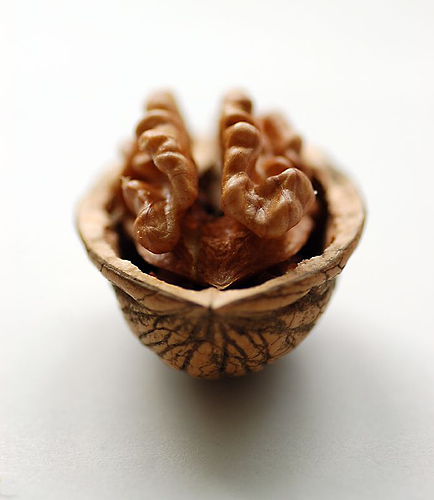
Of Brains & Walnuts

brain-walnut
Brain surgery” (photo by Ilona Angervuo).

Philosophy and the habits of Critical Thinking
Conversation with John Searle

Philosophical Problems

Is it hard to do philosophy?
It’s murder, absolutely. I compare it … if you really want to know how to do it, you get up in the morning, there’s a large brick wall and you run your head against that brick wall. And you keep doing that every day until eventually you make a hole in the wall. That’s what it feels like.

But metaphorically the wall has ceased to exist, right? Using the metaphor that you’re always …

Unfortunately I keep banging the wall. And then once I get one wall battered into shape then I’ve got to work on another one. Now the way it actually works out is that you’re constantly fighting with a whole lot of apparently contradictory ideas, and yet they all seem appealing and you have to find some way to resolve them.

So take an obvious case. We’re all conscious and it’s real. All you do is pinch yourself and you know this is real. How can matter be conscious? You know, what you’ve got in your skull is about a kilogram and a half, three pounds of this gook. It’s about the texture of English oatmeal — it’s slimier. And it’s gray and white. And now how can this three pounds of gook in your skull, how can that have all these thoughts and feelings and anxieties and aspirations? How can all of the variety of our conscious life be produced by this squishy stuff blasting away at the synapses? A hundred billion neurons, glial cells, synapses, how does that produce consciousness? And that’s typical of philosophical problems. On the one had you want to say, well, consciousness couldn’t exist because, you know, how does it fit in with the physical world? On the other hand we all know it does exist, so you have to find some way to resolve that. That’s a typical philosophical problem.

And this has been a major research interest of yours in philosophy.
Well, this one right now is, yes. In my early career I worked on language. My main research was about language and speech. My first two books were about the philosophy of language. But when I was writing those books I kept using mental notions like belief and intention and desire and human action. And I knew some day I’d have to pay off that debt, I’d have to go and write a book about those sorts of things. So I did. I wrote a book called Intentionality. But that left open this whole range of traditional issues in the philosophy of mind. How does the mind work? How does it relate to physical reality? I’ve written several books about those issues. And two things happened. One is, consciousness became a fashionable subject. For the first twenty or thirty years of my career, if you talked about consciousness people thought you’re some kind of mystic or you’re not serious. But that’s changed now. Now it’s a very exciting subject. And the second thing that happened was that cognitive science was created as a new discipline and I was in on that. It was in the late seventies and early eighties that here in Berkeley, and really all over the country, we created this new movement of cognitive science.

As a philosophical issue, what is really exciting about this is that it touches on this whole division between the mind and the body, which is something that philosophy has never really resolved.

That’s why I’m trying to resolve it. What I’m trying to say is we need to get rid of the seventeenth-century categories.

brain-islam
Getting centred” (photo by BidWiya)

We’ve inherited this vocabulary that makes it look as if mental and physical name different realms. And it’s part of our popular culture, so we sing songs about your body and your soul or we have saying about how your mind is willing but your flesh is weak, and sometimes the other way around, the flesh is willing but the mind is weak. And we have inherited, not only philosophically but in our religious tradition, we’ve inherited the idea that there are two quite distinct realms, a realm of the spiritual and a realm of the physical. And I’m fighting against that. I want to say we live in one realm, it’s got all of these features, and once you see that then the philosophical mind-body problem dissolves. You’re still left with a terrible problem in neurobiology, namely, how does the brain do it, in detail? What are the specific neurotransmitters? What’s the neuronal architecture? But I think the philosophical problem, how is it possible that the mental can be a real part of a world that’s entirely physical, I think that problem I can solve.

And how?
The way I solve it is to get rid of the traditional categories. Forget about Descartes’s categories of res existence and res cogitance, that is, the extended reality of the material and the thinking reality of the mental. Once you get rid of the categories and you ask yourself how it works, then it seems to me there are two principles which, if properly understood (it’s not all that easy to understand them, but if properly understood –) provide you with a solution to the traditional mind-body problem. Those principles are first, all of our mental processes are caused by lower-level neuronal processes in the brain. We assume that it’s at the level of neurons, but that’s for the specialists to settle in the end. Neurons and synapses — maybe you’ve got to go higher, maybe you’ve got to go lower — but some sorts of lower-level processes in the brain, whether it’s clusters of neurons or subneuronal parts or neurons and synapses, their behavior causes all of your mental life. Everything from feeling pains and tickles and itches, pick your favorite, to suffering the angst of post-industrial man under late capitalism, whatever is your favorite.

Or stubbing your toe.
Or stubbing your toe. Whatever is your favorite feeling. Feeling ecstatic at a football game, feeling drunk when you’ve had too much to drink. All of that is caused by variable rates of neuron firings in the brain or some other such neurobiological phenomenon, we don’t know in detail what. Okay, that’s principle number one. Brains cause minds. All of our mental life is causally explained by the behavior of neuronal systems.

The second principle is just as important: the mental reality which is caused by the neurobiological phenomena is not a separate substance that’s squirted out. It isn’t some kind of juice that’s squirted out by the neurons. It’s just the state that the system is in. That is to say, the behavior of the microelements causes a feature of the entire system at a macro level, even though the system is made up entirely of those elements that cause the higher level behavior. Now that’s hard for most people to grasp, that you can accept both that the relation between the brain and the mind is causal, and that the mind is just a feature of the brain. But if you think about it, nature is full of stuff like that.

Look at this glass of water, for example. It’s liquid. Now, liquidity is a real feature, but the liquidity is explained by the behavior of the molecules, that is, the liquid behavior is explained by the behavior of the molecules, even though the liquidity is just a feature of the whole system of molecules. I can’t find a single molecule and say “This one is liquid, this one is wet, I’ll see if I can find you a dry one.” Similarly, I can’t find a single neuron and say “This one is conscious or this one is unconscious.” We’re talking about features of whole systems that are explained by the behavior of the microelements of those systems. So I think the philosophical problem is resolved. That is, I don’t have any worry about the philosophical mind-body problem. But the scientific problem — how exactly does the machinery do it? — that’s still very much up for grabs. And I’m in the middle of that battle as well, even though I’m not a neuroscientist. Okay, there are a whole lot of other philosophical problems left over, book cover but that one I’m not worried about.

In one of your most recent books you talk in passing throughout the book about doing philosophy, that’s my interpretation; but at one point you say “It’s always good to remind ourselves of the facts.” You’ve said this is really exciting, and part of the excitement comes from doing this [philosophical] work at the same time that all these biological discoveries are being made.

That’s right. You see, I think in philosophy especially you have to remind yourself of what you know already. We know that the world is made up of entities that we call particles. They’re not exactly particles but that’s close enough. It’s made up of entities, molecules, atoms, sub-atomic particles. It’s made up of these tiny entities and they’re organized into systems. And these systems have causal relations to other systems. So a planet is a system and a water molecule is a system. A baby is a system. There are all these subsystems. And some of those systems have evolved through biological evolution.

We’re carbon-based systems with a heavy dosage of hydrogen, nitrogen and oxygen. That’s our life. We’ve got a thing about these four elements. And those systems evolve across evolutionary time. We know all of that. Now some of those carbon-based, living systems have evolved neuronal systems. Funny kind of cell, the neuron. It’s a cell like any other, but it’s different anatomically. And some of those neuronal systems cause consciousness. Start there. Now that’s how much we know before the philosopher ever goes to work. Then we go to work on that. We don’t go back and think, well, maybe the real world doesn’t exist. No, that’s not an option. So you have to remind yourself of what you actually know.

At one point you’re trying to explain when we do philosophy. This is in … I can’t remember which book this was in, but you say, “As soon as we are confident that we really have knowledge and understanding in some domain, we stop calling it philosophy and start calling it science. And as soon as we make some definite progress, we think ourselves entitled to call it scientific progress.”
That’s right, yes.

So this world you’re in right now, that’s part of the excitement, right?
That’s right. What happens is this.

Philosophy is, in part, the name for a whole lot of subject matters that we really don’t know how to settle the issues in, where we don’t have established methods for resolving questions. Now for me that’s part of the fun, it’s wide open. You’re not hemmed in, you’re not trapped in a narrow little research program. But a lot of people find that uncomfortable, that you can’t fall back on an established body of philosophical truths. Okay, now you have this wide-open area, but as soon as we can get a question into a precise enough form that it admits of a systematic answer that everybody can see is right, we quit calling it philosophy. We call it science or mathematics or logic. And that’s happened in a whole lot of questions. That happened to the problem of life. So at one time: How can inert matter be alive? That was a philosophical issue. Now it’s very hard for us to remind ourselves how important that was. We can’t recover the intensity with which our great-grandparents fought that question. Now we know how it works. And this, I think, will happen to the problem of consciousness. We will get a way of resolving it as a scientific question. This has a funny result for philosophers, namely, this is why science is always “right” and philosophy is always “wrong,” because as soon as we’re convinced that it’s right we quit calling it philosophy and call it science.

So once you have the method of coming up with answers, it’s time for you to close up shop as a philosopher.

Once you have a method that all the competent researchers in the field, I mean there are always a few cranks, but for the most part that the competent researchers in the field can agree is the right method for resolving this problem, then it ceases to be a philosophical problem and it becomes a problem in logic, or it becomes a problem in biology. So the question, “How many carbon rings are there in serotonin?” (that’s a neurotransmitter) — that’s not a philosophical question. But: “What’s the relation of the mental and the physical?” — that’s still a philosophical question. What’s the cause of cancer? That’s not a philosophical question. But what’s the nature of causation? What is it for one thing to cause another thing anyhow? That’s a philosophical question.

brain-tree
The birth of a better Day” (photo by a COWsignal from outer space)

(cont.) The Chinese Room Argument

In your work on the mind and the brain you talk about how there is always a turn in an era to a metaphor that is dominant in technology, hence the dominant one now is to say that the mind is like a computer program. And to answer that you’ve come up with the “Chinese Room.” Tell us a little about that.

Well, it’s such a simple argument that I find myself somewhat embarrassed to be constantly repeating it, but you can say it in a couple of seconds. Here’s how it goes.

Whenever somebody gives you a theory of the mind, always try it out on yourself. Always ask, how would it work for me? Now if somebody tells you, “Well, really your mind is just a computer program, so when you understand something, you’re just running the steps in the program,” try it out. Take some area which you don’t understand and imagine you carry out the steps in the computer program. Now, I don’t understand Chinese. I’m hopeless at it. I can’t even tell Chinese writing from Japanese writing. So I imagine that I’m locked in a room with a lot of Chinese symbols (that’s the database) and I’ve got a rule book for shuffling the symbols (that’s the program) and I get Chinese symbols put in the room through a slit, and those are questions put to me in Chinese. And then I look up in the rule book what I’m supposed to do with these symbols and then I give them back symbols and unknown to me, the stuff that comes in are questions and the stuff I give back are answers.

Now, if you imagine that the programmers get good at writing the rule book and I get good at shuffling the symbols, my answers are fine. They look like answers of a native Chinese [speaker]. They ask me questions in Chinese, I answer the questions in Chinese. All the same, I don’t understand a word of Chinese. And the bottom line is, if I don’t understand Chinese on the basis of implementing the computer program for understanding Chinese, then neither does any other digital computer on that basis, because no computer’s got anything that I don’t have. That’s the power of the computer, it just shuffles symbols. It just manipulates symbols. So I am a computer for understanding Chinese, but I don’t understand a word of Chinese.

You can see this point if you contrast Searle in Chinese with Searle in English. If they ask me questions in English and I give answers back in English, then my answers will be as good as a native English speaker, because I am one. And if they gave me questions in Chinese and I give them back answers in Chinese, my answers will be as good as a native Chinese speaker because I’m running the Chinese program. But there’s a huge difference on the inside. On the outside it looks the same. On the inside I understand English and I don’t understand Chinese. In English I am a human being who understands English; in Chinese I’m just a computer. Computers, therefore — and this really is the decisive point — just in virtue of implementing a program, the computer is not guaranteed understanding. It might have understanding for some other reason but just going through the steps of in the formal program is not sufficient for the mind.

And so the computer program, then, has not explained consciousness.
That’s right. Nowhere near. Now, that isn’t to say that computers are useless and we shouldn’t use them. No. Not a bit of it. I use computers every day. I couldn’t do my work without computers. But the computer does a model or a simulation of a process. And a computer simulation of a mind is about like computer simulation of digestion. I don’t know why people make this dumb mistake. You see, if we made a perfect computer simulation of digestion, nobody would think, “Well, let’s run out and buy a pizza and stuff it in the computer.” It’s a model, it’s a picture of digestion. It shows you the formal structure of how it works, it doesn’t actually digest anything! That’s what it is with the things that a computer does for anything. A computer model of what it’s like to fall in love or read a novel or get drunk doesn’t actually fall in love or read a novel or get drunk. It just does a picture or model of that.

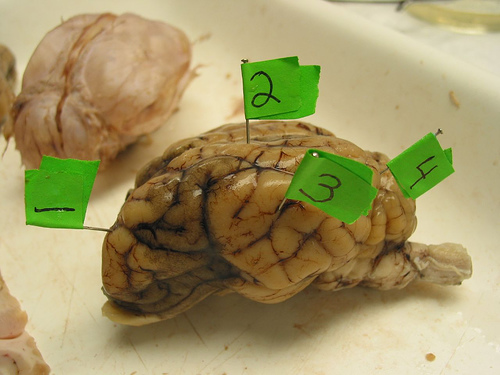
brain-tags
Shell” (photo by the jane).

Being a Philosopher

At one point you say, “We have to begin by approaching the problem naí¯vely. We have to let ourselves be astounded by facts that any sane person would take for granted.” So this sense of wonder and naí¯veté and innocence that you might have is a virtue, in a way.
Yes. I mean that quite literally, and in fact we’ve been exhibiting that just in our discussion. The way that I describe the mind-body problem: you have to allow yourself to be astounded by things that any sane person takes for granted. We’ve got this stuff in our brains, it’s conscious. How the hell can it be conscious? Now that’s the childlike question that you have to ask. When you begin working on a philosophical question you have to be totally naí¯ve. “I’ve got this hole in my face, noise comes out. People find it meaningful. They think it’s true or false or interesting. How can that be? How can just making these noises through my mouth, how can that have all of these remarkable properties?” That’s the naí¯ve stage. Then you have, at some point, to become incredibly sophisticated. You stop being naí¯ve and become immensely knowledgeable, rigorous, and sophisticated. And I’ve never figured out the algorithm for when you stop being dumb and start being smart. But you have to start off very naí¯ve and very dumb. “Oh yes, amazing, how can that be?” Then later on, then you bring in your intellectual apparatus and get it resolved.

But also you have to immerse yourself in the studies, for example, in the case of what’s going on in the mind that science is discovering.

Yes. And the Internet is a disaster, because it means there’s more stuff than ever to read. And the proliferation of good articles — I can’t read all the intelligent attacks on myself. There are just too many! And I can’t read all my e-mail. So the problem is that technology doesn’t give us more time in the day, this is the real problem. And you have to read a lot and I’m sure I don’t read enough. But what I do read I take very seriously.

Now you’ve given us a sense of the domain in which you work, the kinds of problems you work on. What then are the traits that go with doing philosophy well? It sounds like you have to be very patient.

Yes. Well I’m not patient, I know that. I tend to get impatient.

But let me describe some of the traits, I think, that make for a good philosopher. One is you really have to have a kind of openness. You can’t think that you know all the right answers in advance, you’ve got to be willing to be astonished when you go to work on problems. And this has happened to me on a number of occasions. I’ll give one example.

I knew all my life I would some day have to write an article about metaphor: How do metaphors work? And like every American, I’ve been to high school. And like every American, I guess, you think that the stuff you learn in high school must, at some level, be right. In high school they taught us that all metaphors are really similes in disguise. It’s really, when you say “man is a wolf,” you mean “man is like a wolf,” in certain respects. I just assumed that, and then I was astounded to discover that theory doesn’t work. You can’t make that theory work because, well, for a number of reasons it doesn’t work. But that’s an example of how you’ve got to be open. Searle lecturing in the seventies You’ve got to be willing to have your most fundamental beliefs challenged and even refuted. So that’s the first thing.

The second thing is you’ve got to mind your p’s and q’s. You’ve got to make sure that each step follows logically from the earlier steps.

The third thing is, in a way, the hardest of all. You just have to avoid saying things that are obviously false. And you’d be surprised how many famous philosophers say things that are obviously false. I mean, Berkeley says the material world doesn’t exist, it’s all just ideas. A lot of contemporary philosophers say the mind doesn’t really exist, it’s just a computer program or it’s a way we have of looking at things. Consciousness doesn’t really exist, it’s just a certain type of computer program. I would say, if you can proceed rigorously, you have an open mind, and you avoid making obvious mistakes, avoid saying things that are obviously false, well, I don’t guarantee you a successful career in philosophy, but you’re off and running. I mean, you’re doing better than a lot of famous people.

And you have to be argumentative and courageous, right?
Yes, I think it takes a certain amount of courage. If you have a view that you think is right but an awful lot of people don’t think is right, and you publish it and you turn on your e-mail or open the philosophy journals and you find out all these guys think you’re wrong, if you really think you’re right and you really think you have good arguments, you have to have the courage of your convictions. And some people find that difficult. I don’t. I guess my upbringing or my personal style … I don’t mind it if other people disagree with me. I’m sorry that they make these mistakes, but I do what I can to correct them.

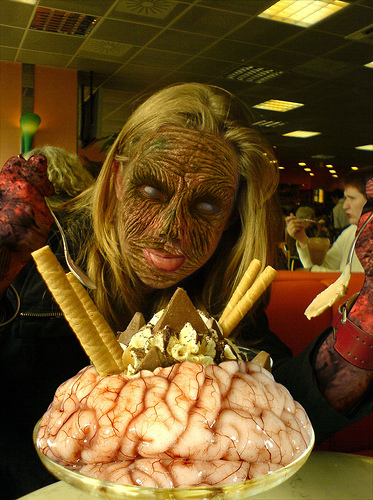
brains-zombie
Zombie Holiday Dessert” (photo by Grabthar)

*Conversations with John Searle: video file.
*Conversations with John Searle: audio file.

CoÃ?â?¹trato

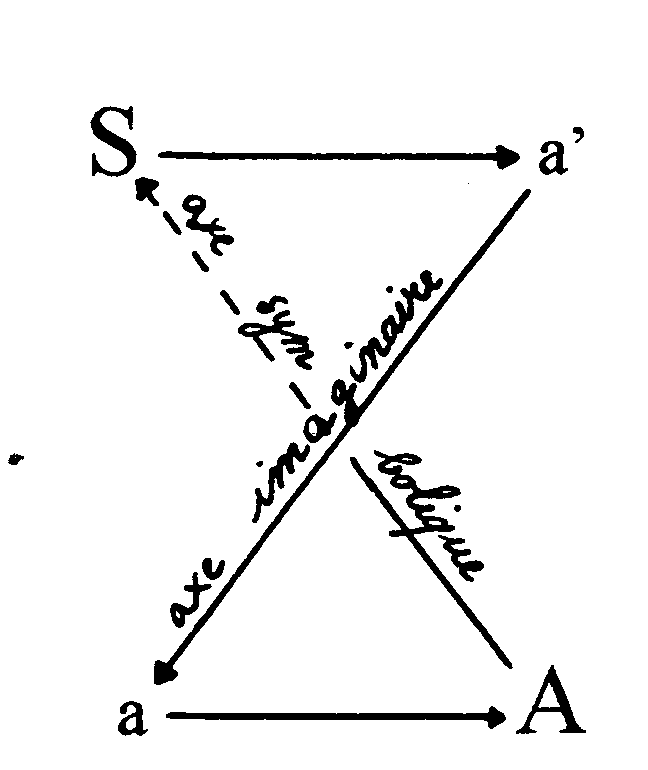
“Onde se fixa a imagem do eu ideal
E onde se determina em espelho o Eu
Em sua Função de rivalidade
de Maestria
de distinção”

( Jacques Lacan – “Estádio do Espelho”)

franck11.gif

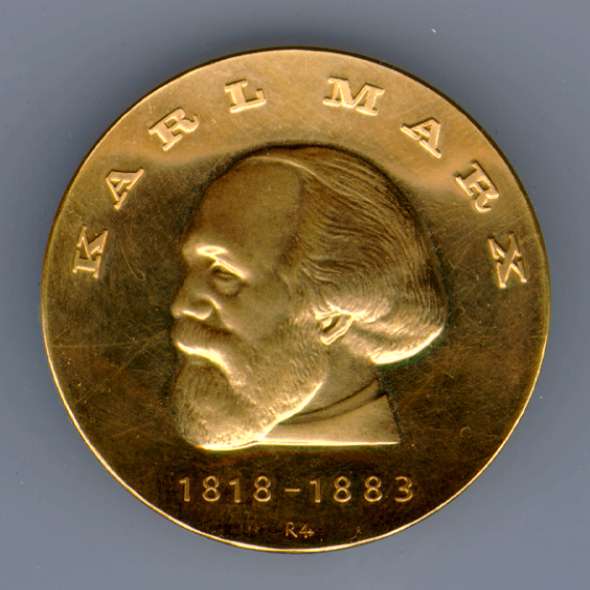
marx.jpg

GUARANI


foto por Mathieu Struck sob esta licença linkada.

Miniature wood statue sculpted in the late 17th century by the guarani indians and the jesuits, used in christian rites and for the decoration of the churches of the region. The museum of Santo Antonio das Missões (southern Brasil) has an impressive collection of indian-jesuit statuary.

08/03 – Dia Internacional da Mulher

gynoid
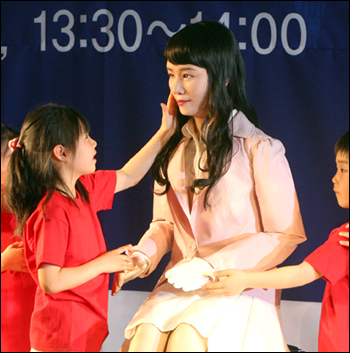
Korean Scientists Develop Female Android

Gynoid (from Greek óÏâ?¦í½í·, gyn – woman) is a term used to describe a robot designed to look like a human female, as compared to an android modeled after a male. The term is not common, however, with android often being used to refer to both “genders” of robot. The portmanteaus fembot (female robot) and feminoid (female android) have also been used; the latter sparingly. The term “Gynoids” was created by the female British SF writer, Gwyneth Jones, and developed by another British SF writer, Richard Calder who lives in Thailand. The word is derived from “Android” which denotes a robot with male attributes. Source: Wikipedia

female_replicant

Os gritos de qualquer paspalho como eu

video do Matema em concerto espetaculoso (no Rock de Inverno 5) em 2004 (por Marcelo Borges)

Trí¤ume dass du wach bist und trí¤umst
Trí¤ume dass du shalí¤fst und trí¤umst
Trí¤ume dass du aufwachst und zu trí¤umen

le_rêve_Q_vouz_REVEILLEZ_pour_rêve
..le rêve que vouz (REVELA!) AU DORT

/* Dream that I dream Awake
Dream that I wake up to dream */

O livro indecifrável na tua prateleira
Os gritos de qualquer paspalho como eu
Pedaços da mesma mentira
Servindo a Industria onde deus dormiu ((ou?)) DEUS MORREU

Pela manhã o sonho pelo ralo
O espelho Arranca o teu Nome Com Sabão
Te fizeram decorar TEUS NOMES
te fizeram {[(desenhar ])}um coração

A indústria da tua realidade te quer pra bater cartão
# -p -e -d -a -ç -o -s
da mesma mentira
pedaços da mesma

ilusão.

Album do Matema completo pra download (ouvir 12 vezes cada musica depois apagar):
http://www.organismo.art.br/matema/album.zip


http://www.organismo.art.br/matema/poemes.html

Eu sol
Me incendeio
Um ou dois fósforos bastam
Palavras não…Juntemos Todas elas…
Mais toda a nostalgia do passado.

[[ Fotos. Revelações.
E claro não se esqueça todos os SE
e os TAlvez…talvez… ]]

Sangro. Eu coração. Faço pela Lua aquela (…)
#)Ela me eclipsa
Sugiro Façamos disso tudo uma grande chama…
*)Fogueira. Incendio.
Pra nos aquecermos numa dessas noites frias
%)Me incinero no auge da minha alquimia

O organismo casulo é sobretudo uma experiência de aprendizado cientí­fico.
Uma nova proposta de acumulação do saber.
O organismo Casulo inicia-se como uma alternativa ao consumo do espetáculo alienante
produzido pelas máquinas corporativas e aos poucos vai tomando lugar como uma nova forma de espetáculo,
aonde a produção de auto conhecimento e reflexão sobre a condição humana é constantemente aprimorada.
O Organismo Casulo é espaço de acumulação e reprodução empí­rica do saber. Como no conceito deleuziano de máquina abstrata,
o casulo está sempre na linha tênue e inví­sivel de uma forma ainda não territorizada. E como o espaço de sua existência são as redes virtuais
sua forma será sempre mutável. Em fases mais avançadas de sua existência, o casulo torna-se um organismo auto sustentável pela própria
comunidade de células que ela vai gerar ao redor do mundo, que por sua vez estará gerando novos organismo casulo
trazendo um equilí­brio e auto-crí­tica no maquinário de exercí­cio de influências e no próprio conceito de organismo casulo.

Como aquilo que no organismo, dissolve e Coagula..
É a estrela que sangra..e dá a luz a tal estrela que dança… teu suor nos esquenta..
o que sangra o sol.. sangra a lua… o que segue o sol … segue a lua … o que cega o sol cega a lua…

Dissolve e C o a g u l a …

B – F# – E – Bb – C – F – C# – G – D – A – Ab – D#

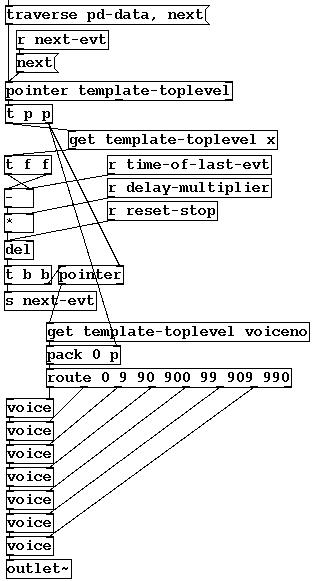
patch

http://organismo.art.br/puredata/

interface


control shift b
é:
bang é um botão “faça”

control 2
é uma mensagem
control 1 é um objeto
cada objeto é um programa

control shift chama-se toogle é um “liga e desliga”
o metro em milisegundos
500 milisegundos é correspondente í  seminima a 120 – 0.5 hertz
a mensagem “sei lá” a cada meio segundo aciona o bang
o pulso de refresh é de 60 hertz
ou seja, 250 milisegundos

control 3 é numero inteiro
array – vetor / tabela
control 5 é comentário

som do oscilador

A4 – 69 – 440 hz

o objeto gráfico fala diretamente com o sistema ou com outros objetos

Eterno

As janelas mudaram de cor e ainda são incompreensí­veis os ventos que sopram os nimbos nos últimos seis meses. Faz frio e as tormentas são noturnas. Um entrecortado de vazios entorpece e como que pára este tempo. Lugar de sombras ou de profundo amor. Ponta de precipí­cio ou beirada de túmulo. Flores murchas e o odor úmido do decompor atravessam as horas presas nas carnes quase usufruí­das como prostituição, puramente. Arremetidas. Retido. Flores fadadas í  secura e í  escuridão segundo grita um oco lá do infinito das gavetas de memórias e instintos. Embora felizes com as passagens velozes de quase amor, os dias de ausência cobrem as pernas de veias. O envoltório da Alma repetirá o destino destas murchas e ensimesmadas pétalas de mãos dadas. As pequeninas, por não poderem andar, restarão presas ao vaso mal cuidado, sua terra velha semi-árida e as beiras com lascas adquiridas ao longo dos tratos. Flores e Alma a sentirem o aroma da morte. Sem pernas na beirada de um túmulo, murcharão, por destino, inevitavelmente, jazendo simplesmente como margaridas esquecidas que são. O corpo, em pó esmaecido, padecerá do suplí­cio eterno da constatação de que quanto mais antigo o túmulo, mais sozinho.

O REI EST� NU!

antipostal
Antipostal, foto tirada em 2002, por Daniela Mattos: humor contra o estelionato cultural.

Há mais de 2 mil anos, o estrategista chinês Sun Tzu, autor de A Arte da Guerra, já dizia: “Toda a arte da guerra tem por base o logro”.

171

Por Rubens Pileggi Sá

“AMOR: humor”
Oswald de Andrade

171 é um artigo do código penal, sobre estelionato, mas que se transformou em gí­ria para designar alguém malandro, sempre tentando dar um golpe, vendendo o que não possui, entregando documentos falsos em lugar dos verdadeiros, enganando, mentindo, levando prejuí­zos dessa espécie a quem lhe aparecer pela frente.

171 é aquele polí­tico que não tem nada a perder em uma eleição e promete até trazer as próximas olimpí­adas para a cidade, motel de graça para todos, acabar com os impostos, arranjar até namorado(a) para quem não tem. É aquele tipo de polí­tico que sempre coloca o verbo na primeira pessoa, repetindo o bordão do fez e vai fazer mais. Que sempre tem um ílib (sic) contra quem o denuncia como desonesto e corrupto. Por sorte, não temos deles por aqui!

171 é aquele sujeito que tira “um sarro” em todo mundo e muita gente ainda acredita em suas palavras como se fossem sérias e verdadeiras. O 171 sabe que não adianta levar a vida tão í  sério, afinal, dela ninguém sairá vivo, como já disse o compositor Belchior. O 171, por fim, garante-nos a diversão e o entretenimento, com sua “lábia”. 171 é o palhaço da ocasião, aquele que nos obriga í  risada constrangida. É o enganado que aprendeu com o enganador o exercí­cio da sobrevivência. É o anti-herói por excelência. É o nosso Macunaí­ma. É o que há de mais profundamente verdadeiro em cada um. Em cada um de nós, brasileiros.

Transformar esse método em piada é a única chance de não se deixar contaminar por algo que poderia nos tirar o humor. Devolver ao 171 – sob forma de chiste, blague, blefe – a mentira que, de tanto repeti-la, ele próprio acaba acreditando, é a melhor arma. Responder-lhe com argumentos sérios ou indignados seria como que validar sua posição. Seria dar corpo a um engano.

No fundo, no fundo, é isso que se espera, também, da arte. Da verdadeira Arte. A arte como engano, como “vontade de ilusão” , como já disse o filósofo. E nada melhor para aceitar o engano do que o humor.

Marcel Duchamp foi, talvez, o primeiro artista a se dar conta desse “jogo de enganos”, ao deslocar do objeto para a idéia, a “aura” que até então cobria a arte. Ao eleger um banquinho com uma roda de bicicleta como peça de arte, todo o entendimento que se tinha, até então, de arte como “ciência do belo”, caiu por água abaixo. Ao retirar um objeto industrial de sua função e colocá-lo dentro de um museu de arte, chamou í  responsabilidade os artistas para o mundo em que estão inseridos. Não dava mais para o artista ficar de costas para a realidade, mudando cores para lá e para cá. Era preciso mais. Era preciso se posicionar. Arte passava a ser sinônimo de atitude. Aos que lhe perguntavam se sua atitude era uma ironia, respondia que não, que sua atitude tinha era “humor”. O que podia ser uma ironia, mas não deixava, de qualquer modo, de ser, também, humor.

Humor é uma estratégia da qual muitos artistas e movimentos têm lançado mão, desde então. O movimento “Força Jovem” é um deles. Inspirado em slogans de campanhas eleitorais e na eterna relação entre a juventude e o novo (sí­mbolo antigo do modernismo), brinca com sí­mbolos e mitos revolucionários, vendendo carteirinhas de anarquista, atestado de herói, passe de lí­der, etc e utiliza-se da mais deslavada cara de pau para anunciar a redenção pelo futuro, com frases vazias, mas cheias de efeitos. Seu assumido cinismo o torna politicamente incorreto, e, ao mesmo tempo, crí­tico feroz da cooptação de quem usa a ingenuidade alheia para dela tirar partido.

O Stressionismo é outro movimento – movimento, não, surto! – cuja poética “está fundamentada na falta de poética”, segundo seu criador Wilson Inácio (www.stressionismo.hpg.ig.com.br) . O manifesto Stressionista prega que “todo artista é um crí­tico, mas nem todo crí­tico é um artista”. O ví­deo que apresenta trabalhos stressionistas começa com a gravação de uma fita cassete, parada, enquanto uma voz feminina diz coisas como: “o stressionismo quer defender a culinária enquanto arte. Comer é privilégio de poucos. A Arte, também”.

Outro “movimento surgido recentemente é o “Miguelismo”. Miguelismo, vem de “Migu锝. Dar uma de “Migu锝. De “João-sem-braço”. De conversar, tentando convencer. Ou de fingir que não é consigo a questão. Seu “fundador”, João Fábio, inventou até uma exposição relâmpago de suas pinturas, cujo evento recebeu o sugestivo nome de C.I.P.í. (Circuito Independente Paralelo de Artes), mostrando que até na falta do que dizer, “si pá, joga um migué que cola”. Essa a lei do 171. Pode parecer ridí­culo, e o é, mas é incomparavelmente mais corrosivo e inteligente do que querer se passar por sério, fingindo-se estar acima do sarro e da gozação.

Os ingredientes finais para o sucesso são as altas somas de dinheiro em jogo e a arte do blefe: um jogador pode vencer uma partida mesmo com cartas ruins na mão, desde que faça seu adversário acreditar no contrário, por meio de gestos, olhares e apostas.

axis mundi

axis mundi (by Mathieu Struck)
Photo: Mathieu Struck
Creative Commons License

The Human Abstract
(William Blake)

Pity would be no more
If we did not make somebody poor,
And Mercy no more could be
If all were as happy as we.

And mutual fear brings Peace,
Till the selfish loves increase;
Then Cruelty knits a snare,
And spreads his baits with care.

He sits down with holy fears,
And waters the ground with tears;
Then Humility takes its root
Underneath his foot.

Soon spreads the dismal shade
Of Mystery over his head,
And the caterpillar and fly
Feed on the Mystery.

And it bears the fruit of Deceit,
Ruddy and sweet to eat,
And the raven his nest has made
In its thickest shade.

The gods of the earth and sea
Sought through nature to find this tree,
But their search was all in vain:
There grows one in the human Brain.

(Proximidades de São Luiz Gonzaga-RS, janeiro-2007)

torço pra que o robô delete e/ou manchete sem foto, há cores.

simples se fosse só caospital
macaco puxando bugio lesado de volta pra espantar chuva
pra espantar ví­rus da gripe surtando que urro ou rabisco é penicilina
eloquencia da lesão do esforço repetitivo
banaliza eloquencia
dispensa a trema
aki. com ponto.

isso não é verso
e tua gramática que se molde no sono do ââ? Â

todas tuas subsâncias anestesicas

vetor

teu desespero servidão
se move se culpa por mascar o osso do morto
mente que viu o que pensa virar carne
liga a caixa dissimula o autismo

epifaniza o delí­rio da dicionária

multiplica os corpos
justifica os copos
cospe em silêncio os totens nomes-próprios a não-reler

acabou-se o fim do mundo

seios para um novo reino
genêros pra quem verte leite

tua culpa – tu que decidiu prover sentido

e do analfabeto ao rabisco, do rabisco ao gesto

do tropeço ao ââ? â??

I LOVE THIS COMPANY, YEAH!

surplus

Charuto Cubano: As sociedades de consumo
destruí­ram o meio ambiente.
Exterminaram milhões de espécies
de plantas e animais.
Envenenaram os mares,
os rios e os lagos.
Poluí­ram o ar.
Encheram a atmosfera com dióxido
de carbono e outros gases nocivos.
Destruí­ram a camada de ozônio.
Esgotaram nossas reservas
de petróleo, carvão e gás natural,
além das fontes de minério.
Exterminaram nossas florestas
e destruí­ram suas próprias.

E o que restou para nós?

Subdesenvolvimento. Pobreza.
Dependência. Atraso.
Dí­vidas. Incerteza.

Para as sociedades superdesenvolvidas,
o problema não é o crescimento,
mas a distribuição.
Não apenas entre eles mesmos,
mas entre todos.

O desenvolvimento sustentável
é impossí­vel
sem uma distribuição mais justa
entre todas as nações.

Antes de tudo, a humanidade
é uma grande famí­lia
que compartilha o mesmo destino.

Dada a severa crise atual,
estamos diante de um futuro ainda pior,
que nunca nos permitirá
resolver a tragédica econômica, social
e ecológica de um mundo
cada vez mais fora de controle.

Alguma coisa precisa ser
feita para salvar a humanidade.

Um mundo melhor é possí­vel!
Dano í  propriedade,
destruição da propriedade.
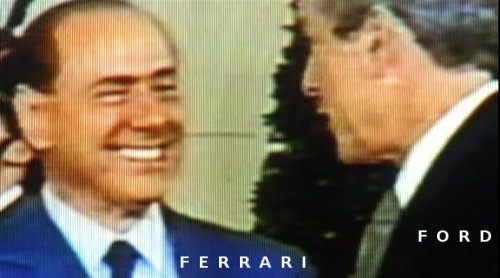
Ferrari: Aqueles que vieram aqui,
para se manifestarem pacificamente,
não puderam fazê-lo
por causa de certos indiví­duos
com uma quase profissional
dedicação í  violência.

Coquetel Molotov: Dano í  propriedade não é violência. Um edifí­cio
ou uma janela não podem ser violentados.
É diferente para nós
da questão da violência.
Isso não é violência, a não ser que
se trate de ataque a indiví­duos.
Coisa que não fazemos.

Pessoas: Polí­cia… Assassina!

Coquetel Molotov: A elite estava em pânico,
especialmente depois de Seattle.
Estavam como que
buscando as causas.
E o único nome ao
que poderiam associar era John Zerzan.

Se você está buscando
a mente por trás de movimento,
ela é definitivamente John Zerzan.
Ele escreveu um livro,
dizendo que para salvar o mundo
devemos voltar
í  idade da pedra.
E o modo de chegar lá é
destruir a indústria e tudo mais.

Doador de Sangue: É meio curioso ou estranho
que eu tenha sido chamado
o arquiteto da tática de
destruição da propriedade
ou do ativismo Black Block.
Isso certamente não é verdade.

Coquetel Molotov: Zerzan tem uma vida modesta, e por
muito tempo sua única fonte de renda
vinha a partir da
doação de seu próprio sangue.

Doador de Sangue: Nós estamos tentando estimular
apenas o questionamento.
Por que as pessoas vão lá fora e tentam
protestar ou fazer alguma coisa?
Isso não é violência insensata.

A insensatez é sentar ali,
drogar-se, assistir í  MTV.
E então você arranja um emprego e cai
na submissão. Para mim essa é a violência.

Há cada vez mais sinais
em todo lugar
de que a vida do consumismo
não é nada satisfatória.

Tio Sam: Não podemos deixar com que o
terrorismo atinja seu objetivo
de intimidar nossa nação
o ponto de que não possamos mais…
Onde as pessoas não possam mais comprar.

Doador de Sangue: A vontade de consumir te aterroriza.
Somos aterrorizados para
nos tornarmos consumidores.

Nós temos a liberdade de escolher
entre as marcas A e B.
É essa a liberdade que temos.

Tio Sam: Não podemos deixar com que o
terrorismo atinja seu objetivo
de intimidar nossa nação
ao ponto de que não possamos mais…
…não possamos mais
conduzir nossos negócios.
Onde as pessoas não possam mais comprar.

Doador de Sangue: Sim, eu acho que há coisas demais.
Trabalhar constantemente
e consumir constantemente. É loucura.

Está destruindo tudo,
vai tudo desaparecer.

Eu vejo muito pouco
do que vale a pena preservar.

Não é proveitoso ou saudável
manter esse sistema.

Conseguir todas essas coisas
é uma questão de compulsão.
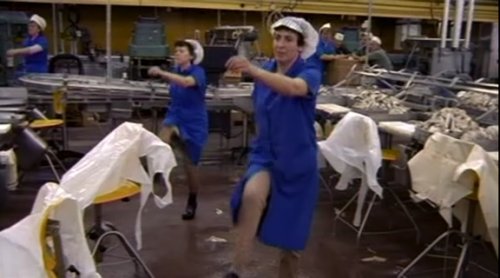
surplus-34.jpg

Pessoas são obrigadas a trabalhar
em minas e em linhas de produção.

Sem essas coisas, nós não temos
tudo isso. Um mundo de coisas
para as quais devemos lutar
na formação das nossas vidas.

Eu acho que ninguém leva isso a sério,
mas a inércia se encarrega de levar tudo adiante.

Isso precisa parar.
Isso precisa ser destruí­do.

Charuto Cubano: Eles andam pelas ruas, expostos
ao constante veneno da propaganda,
semeando a fantasia, a ilusão
e o desejo do
consumo impossí­vel.

Nós teremos um novo mundo.
Onde as pessoas não compram.

Consciência: O desejo de consumo te aterroriza.
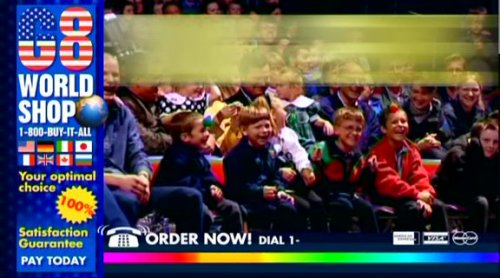
surplus-5.jpg

Televisor: Acho que os jovens de hoje
não têm nenhum futuro.

Coquetel Molotov: Acho que todos no
mundo agora podem sentir…

…podem sentir a força dessas
grandes corporações multinacionais

que estão efetivamente
começando a dominar o mundo.

Essas grandes
corporações multinacionais
gastam 400 bilhões de dólares
por ano tentando nos vender
fast food e carros, então é claro
que isso provoca um grande impacto em nós.

O comercial de TV de 30
segundos é a mais poderosa
peça de comunicação que os
seres humanos já criaram.

Você…
…está sentado na sua poltrona,
passivo, sem nada a dizer.

Enquanto lá fora há pessoas espertas
fazendo programas de TV e comerciais fantásticos.
Eles são os poderosos produtores
da informação e do significado.

Você é o consumidor passivo
de todo esse significado.
E o significado não é nada bom.
É apenas propaganda para a cultura de consumo.

Você pensa que felicidade é comprar
cada vez mais, especialmente no Natal.
Vamos aos shopping centers
e comprar coisas pra caramba, sabe como é?

Vendedor: O cliente pode escolher o
tipo do corpo e o da cabeça.
Então ele escolhe
a cor da pele,
a maquiagem, incluindo
a cor da boca,
a quantidade de sombra nos olhos,
delineador. Eles escolhem a cor do olho,
a cor do cabelo, o tipo de cabelo,
as unhas, praticamente tudo.
surplus-8.jpg

Eles podem escolher exatamente o que quiserem.
A diferença entre nossas bonecas e
a maioria das que você vê por aí­ é óbvia.
Nós usamos técnicas hollywoodianas
de efeitos especiais para fazê-las.

Se formos pra ali dentro,
eu posso te mostrar cinco delas.

Esse é o tipo de cabeça ní° 3.
Ela se adapta a certos corpos.
As cabeças e corpos são combináveis.
Esse é o tipo de cabeça ní° 2.
Esse é o tipo de cabeça ní° 6.
Está sem cabelo por enquanto.
Essa é outra cabeça, ní° 7…
Essa é a cabeça 4… e cabeça 8.

Estamos lançando agora o boneco masculino.
Aqui está um dos corpos masculinos.
Ele está sem a
“coisa” ainda, mas…
Se você olhar ali
naquele canto, há um.
Esse na verdade é careca.

Esse é o corpo tipo 5.
Pequeno com seios bem grandes.
Este é um dos corpos mais recentes.
Esse é o corpo tipo 2, que também
é pequeno, mas com seios um pouco menores.
Mas são ainda de um bom tamanho.
Esse é o corpo tipo 4, que é pequeno
com seios também bem pequenos.
E aqui está outro ní° 2…
Esse é o numero 1,
bem mais alto que os outros.
Esse é um corpo do tipo top-model,
bem magro e alto,
pra quem gosta desse biotipo.

Elas não são baratas. Cada uma dá
bastante trabalho, usamos materiais caros.
então elas custam algo
entre 6 e 7 mil dólares,
dependendo do corpo
e se é feminino ou masculino.

Veja, os seios são macios,
preenchidos com silicone mais macio.
Então eles são mais macios
que o resto do corpo.
É uma das caracterí­sticas de venda
que mais atraem os consumidores.
surplus-10.jpg

Mentirosos: …o PIB, PIB, PIB…

…um por cento.
…um por cento.
…um por cento.

Doador de Sangue: Dizem que o futuro
tecnológico dá poder í s pessoas,
torna-as mais próximas,
dá a elas acesso í 
variedade…

Disseram-nos que a
tecnologia libertaria as pessoas
e elas não teriam
que trabalhar tanto.

Viajo por todo lugar e só escuto
as pessoas dizendo:

“Tenho meu bipe, meu
celular, meu…”

Não posso nunca me afastar do trabalho.
As pessoas estão em uma coleira eletrônica
com todos esses novos aparelhos.
Elas estão cada vez menos
separadas do trabalho e da tecnologia.
surplus-12.jpg

Ví­rus: Como usamos Bluetooth,
Como usamos 3G…
Será possí­vel
ficar em casa e trabalhar
apenas realizando uma ví­deo-conferência
com seus colegas de trabalho.

O computador será a melhor
ferramenta de socialização.
É realmente uma ferramenta
que pode aproximar as pessoas
mais do que isolá-las.

Doador de Sangue: A moderna tecnologia favorece
mais o distanciamento do que a proximidade,
a eficiência sobre a diversão.

Variedade…

Eu gostaria de ver
um projeto gigantesco de demolição.
Para nos livrar de todas essas coisas.
Para arrancar as estradas e as ruas.

Livrar-nos de tudo isso que se baseia
na destruição da natureza
e que nos separa dela,
que mantém as pessoas nessa monotonia
de trabalhar constantemente
e consumir constantemente. É loucura.

Isso está destruindo tudo,
vai tudo desaparecer.

Consciência: Um norte-americano comum consome
5 vezes mais que um mexicano.
10 vezes mais que um chinês.
E 30 vezes mais que um indiano.

Dez…

Trojan Macedo: Empreendedores, empreendedores, empreendedores…

Nove…

Coquetel Molotov: Acho que todos no
mundo agora podem sentir…

Oito…

…podem sentir a força dessas
grandes corporações multinacionais.
Muitas dessas empresas são mais
poderosas até do que governos.

Sete…

O primeiro mundo…

Seis…

…nós somos 20 por cento
da população mundial.
Mas consumimos 80 por cento
dos recursos do planeta.
Esse ní­vel de consumo
é simplesmente insustentável.

Se continuarmos a
consumir nesse ní­vel,
certamente iremos bater
contra a parede.

Cinco…

Se formos idiotas ao
continuar não escutando

Quatro…

os primeiros sinais de aviso
que o planeta está nos mandando,

Três…

teremos uma era terrí­vel e talvez
levaremos séculos para a cura do planeta.

Dois…

Haverá um colapso
econômico mundial.

Um…

Haverá um colapso
econômico mundial.

Zero

Ignição

Decolar!
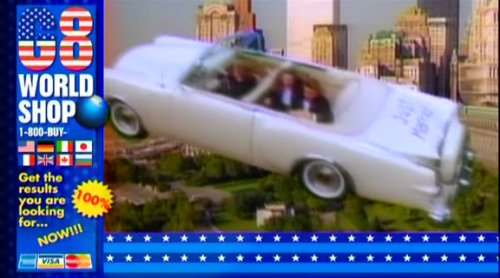
surplus-7.jpg

Charuto Cubano: Quanta porcaria!
É repugnante o comportamento de muitos
lí­deres ao assistirem, como a um castelo
de cartas desmoronando, ao colapso
de seus modelos econômicos.
Cuba não promove o consumismo!
Viva o socialismo!
Pátria ou morte!
Venceremos!
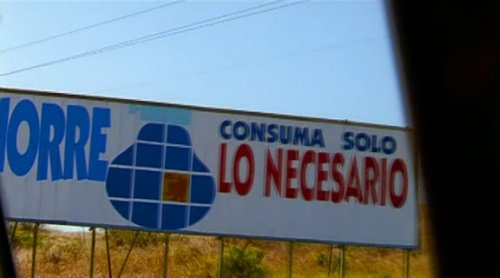
surplus-21.jpg
ECONOMIZE: CONSUMA APENAS O NECESSíRIO

Dona da Bodega: Você tem um cartão com todas as
coisas que você pode pegar do armazém.
Isso é arroz, isso é feijão,
isso é óleo, de cozinhar, é claro,
açúcar, sabão e ali
vai estar a pasta de dentes.

Você pode ter tudo.
Isso é carne, isso é pão…
Você pode notar que temos cotas
diárias de pão. Todo dia, todo mês.
Janeiro, fevereiro, março…
Bom, é isso.

Você tem esse cartão,
vai até o armazém
e todo mês eles te dão uma cota
de acordo com o sistema de consumo.
Acho que é um sistema muito bom
para que cada um tenha
pelo menos suas necessidades
básicas cobertas.

Animador de Festa: E agora nosso lí­der supremo:
Comandante-chefe Fidel Castro Ruz!

Pessoas: Fidel, com certeza,
pros ianques não dá moleza!
Fidel, com certeza,
pros ianques não dá moleza!
Fidel, com certeza,
pros ianques não dá moleza!

Charuto Cubano: Distintos convidados.
Queridos compatriotas…

Risonha: Arroz.
Feijão.
Arroz e feijão.
Arroz, feijão.

Para um cubano, viajar é
um grande acontecimento.
Eu fui í  Europa com uma
carta-convite de um amigo.
Na primeira vez em que fui a um
supermercado, meu queixo caiu.
Tudo foi um grande choque.
Existe tanta coisa de tudo.
Maçãs, pêras, bons perfumes,
xampus bons, tênis.
E foi assim.
Fui muito bom, muito mesmo!
surplus-47.jpg

Dona da Bodega: Nós a chamamos de pasta de dientes.
Sua marca é Perla. Todo mundo conhece.
Nem precisam mais colocar a marca no produto.

Charuto Cubano: Cuba não promove o consumismo.
Cuba não se utiliza da propaganda.
Cuba, nosso paí­s, é de longe
o mais democrático
paí­s do planeta.

Risonha:
Na Inglaterra eu não comi feijão.
Não queria comer feijão.
Eu disse: “Eu não quero feijão,
quero alguma coisa diferente.”

A primeira coisa que fiz
foi ir ao McDonald’s.
Eu queria ver o McDonald’s.
Eu queria… Meu Deus!
Um Big Mac, um grande, grande Big Mac!

E eu via a TV,
trocava os canais, comia…
Eu cheguei em casa,
81 quilos, 81 quilos!

Tanta comida!
Comendo, de novo e de novo!
Eu sempre estava com fome,
meu corpo pedia por mais!
Comia e assistia TV.
Música. Programas musicais…
McDonald’s, Burger King…

Charuto Cubano: Quanta porcaria!
A economia global de hoje
é um cassino gigante!

Consciência: O Natal parece ter chegado
mais cedo em Wall Street neste ano.
As cada vez mais absurdas ações
de internet aumentaram de novo ontem.
Spray tem 50 empregados
da geração Nintendo,
que sabem tudo sobre internet
e trabalham por puro prazer.

Svante é um tí­pico jovem
da sociedade da informação.
Com apenas 19 anos, já milionário, vai
freqüentemente a trabalho para San Francisco.

Volvo:
Cerca de 1 ou 2 milhões.
– 3 milhões e meio.
– 5 milhões.
– Quase 10 milhões.
– 14 milhões.
18 milhões…

Lá no fundo eu odeio dinheiro, e
não quero pensar mais sobre isso.

É engraçado, metade do meu tempo se destina
a achar maneiras de gastar meu dinheiro.

É tudo tão fácil.
Tenho tudo quando eu quiser,
todo o dinheiro que quero.
Não tenho nenhum problema.

às vezes eu realmente sinto
falta da vida dura de antes, mesmo.
Pensar que seria difí­cil
gastar dinheiro. Posso viajar…
Há tantas maneiras simples
de gastar dinheiro.

É como: “Não tem problema,
vem comigo, meu bem…”
Mas sei bem que não é fácil,
toda minha energia está centrada nisso.

É isso o que me leva cada vez mais
pra dentro de mim mesmo, eu me sento e…
Estou tão vazio.
Quero encontrar um propósito pra isso tudo.
Preencher meu espí­rito com alguma coisa.
É engraçado, metade do meu tempo se destina
a achar maneiras de gastar meu dinheiro.

Minha mãe me disse ontem:
“Quem dera se você não tivesse esse dinheiro”.
“O que você está falando?” – “Quem
dera se você não tivesse esse dinheiro!”
surplus-13.jpg

1 milhão.

2 milhão.

3 milhões e meio.

5 milhões.

Cerca de 10 milhões.

14 milhões.

18 milhões…

Era um excesso constante,
e você se acostuma a ele.
Um carrossel de dinheiro
que saiu de controle,
e em retrospectiva tudo
me parece tão idiota.

Quem vai querer isso, realmente? Ninguém.

Posso comprar um bom apartamento,
e me sentar ali, numa boa.
E então eu posso conhecer uma garota,
impressioná-la com meu apartamento.
Eu poderia dizer: “Minha querida,
vamos nos casar e comprar uma casa.”
E quando tivéssemos filhos,
então – opa, tudo acabou.

Opa, tudo acabou.

às vezes eu realmente sinto
falta da vida dura de antes, mesmo.

18 milhões.

14 milhões.

10 milhões.

5 milhões.

3 milhões e meio.

2 milhões.

1 milhão.

1 milhão.

1…

Doador de Sangue: Uma existência confortável,
uma carreira, todas as promessas
de bem-estar material
são um tanto vazias.
Algumas pessoas certamente
compreendem esse vazio,
bem como os sérios limites
da realização e da liberdade.

De outra forma elas não
o fariam. Elas diriam:
“Vou apenas conseguir um emprego
e ser feliz.” Bem, quem é feliz?

Animador de Festa: Senhoras e senhores: Steve Ballmer!
surplus-20.jpg

Trojan Macedo: Vamos lá! Levantem! Vamos!

Eu tenho quatro palavras pra vocês:

Eu…

Amo…

Esta…

Empresa!

YEAH!!!!

Consciência: Mais uma vez…

Tio Sam: Estou clamando por uma nova ética.
Os paí­ses desenvolvidos têm o dever
de não apenas dividir nossa riqueza,
mas também o de promover fontes
de produção dessa riqueza.

Doador de Sangue: Por que as pessoas vão lá
fora e tentam protestar
ou fazer alguma coisa?

Isso não é violência insensata.
A insensatez é sentar ali,
drogar-se, assistir í  MTV.
E então você arranja um emprego e cai
na submissão. Para mim essa é a violência.

Danos limitados í  propriedade
ou destruição da propriedade são necessários.
Isso quebra os limites
da “polí­tica comum”.

O que você conquista segurando uma
placa em um desses “protestos comuns”?
Por décadas eu vi isso.

Não adianta nada.

As pessoas não dão atenção. Por que
elas dariam? Não vale a pena.
Mas quando as pessoas lutam,
isso é alguma coisa.

Isso atrai e realmente deveria
atrair, porque é real.
Não é apenas um jogo simbólico de “Eu me
sinto bem. Eu tenho minha placa de protesto.”

Bem, eu não dou importância a isso.
Se isso fosse válido,
se fosse eficiente…
Eu preferiria uma manifestação pací­fica.
Ninguém correria riscos.
Ninguém se machucaria ou seria preso.
Ninguém seria atingido na cabeça por um policial.
Nem mesmo uma janela seria quebrada. Perfeito.

Mas a coisa não funciona dessa forma.

Dano í  propriedade…

Destruição da propriedade…

Tio Sam: Estou clamando por uma nova ética.

Doador de Sangue: As propriedades corporativas são os alvos
legitimamente mais óbvios para mim.
Bancos, lojas caras e franquias
como a Starbucks e outras.

As pessoas as percebem como parte
de um sistema global, parte desta forma
abusiva, regulatória
e destrutiva,
que está acabando com todas as
diferenças, toda a liberdade.

As pessoas de 2 milhões de anos
atrás não destruí­am a natureza.
Elas não faziam guerras.
Tinham tempo livre e tudo mais.

É o que se entende por
primitivismo, de certa forma.

E para mim isso é muito inspirador.
surplus-40.jpg

Coquetel Molotov: Neste novo mundo…
Neste novo mundo…
Neste novo mundo, as pessoas
recuperariam sua própria cultura.
Terí­amos um novo conjunto de
valores. Uma mudança de paradigma.

Uma grande mudança mental global,
em que as pessoas rapidamente diriam:

“Eu não quero um carro da moda.”

Em que as pessoas rapidamente diriam:

“Eu não quero outro Big Mac.”

Em que as pessoas rapidamente diriam:

“Eu não quero vestir

um jeans da Diesel.”

Em que as pessoas rapidamente diriam:

“Eu quero ter uma vida

simples e prazerosa.”

Em que as pessoas rapidamente diriam:

“Eu quero ter uma vida

simples e prazerosa.”

Risonha: Eu quero alguma coisa diferente.
surplus-46.jpg

Tio Sam: …uma vida simples e prazerosa.

**Legenda do filme Surplus (2003) de Erik Gandini
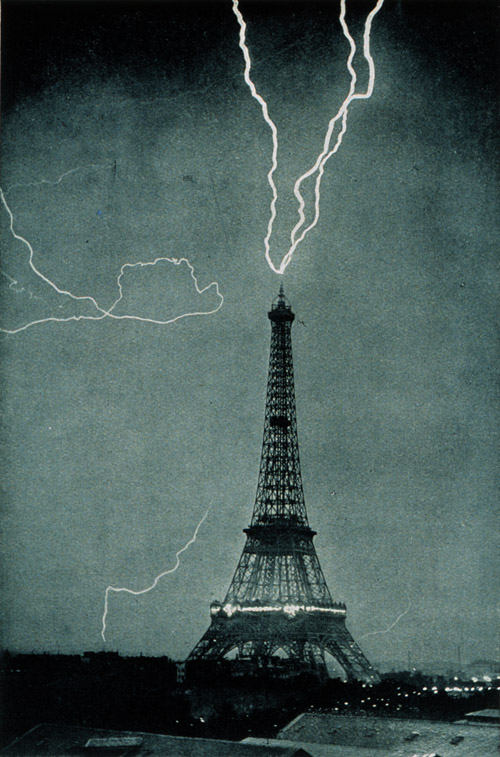
Move 36. Now itôs your turn.

Brain and Body

Knowledge and will
As discussed in sections knowledge and will, we understand knowledge as a model, or recursive generator of predictions; while will is that agency which selects, or resolves uncertainty, in systemic processes. Knowledge and will are intimately related in the actions of all neural systems: the availability of knowledge acts as an a priori constraint on the range of possible actions; while the will selects a final action from that set.

In our thought and language we distinguish two different classes of elements which we say exist: our beliefs, expressing what we think we know; and our desires or intentions, expressing what we are striving for and intend to do. We can describe the elements of the first class collectively as knowledge, and the elements of the second class as will. They are not isolated from each other. Our goals and even our wishes depend on what we know about our environment. Yet they are not determined by it in a unique way. We clearly distinguish between the range of options we have and the actual act of choosing between them. As an American philosopher noticed, no matter how carefully you examine the schedule of trains, you will not find there an indication as to where you want to go. We think about knowledge as a representation of the world in our mind.

Another way to describe the relation between knowledge and will is as a dichotomy between not-I and I, or between object and subject. The border between them is defined by the phrase “I can”. Indeed, the content of our knowledge is independent of our will in the sense that we cannot change it by simply changing our intentions or preferences. On the contrary, we can change our intentions without any externally observable actions. We call it our will. It is the essence of our “I”.

Source: Principia Cybernetica

Brain in Action


ON SLEEP AND SLEEPLESSNESS
Aristotle (350 BC)

WITH regard to sleep and waking, we must consider what they are:
whether they are peculiar to soul or to body, or common to both; and
if common, to what part of soul or body they appertain: further,
from what cause it arises that they are attributes of animals, and
whether all animals share in them both, or some partake of the one
only, others of the other only, or some partake of neither and some of
both.
Further, in addition to these questions, we must also inquire what
the dream is, and from what cause sleepers sometimes dream, and
sometimes do not; or whether the truth is that sleepers always dream
but do not always remember (their dream); and if this occurs, what its
explanation is.
Again, [we must inquire] whether it is possible or not to foresee
the future (in dreams), and if it be possible, in what manner;
further, whether, supposing it possible, it extends only to things
to be accomplished by the agency of Man, or to those also of which the
cause lies in supra-human agency, and which result from the workings
of Nature, or of Spontaneity.

Measure of the Head


Cuidados com seu pitbull

Uma boa caminhada é um exercí­cio bem gostoso para o cão, deixar ele cheirar e fazer xixí­ faz parte do processo, o passeio deve ser agradável ao cãozinho, importante estar em ordem com a vacina, particularmente aconselho reservar o filhote até completar a carteira de vacinas e só depois apresentar o passeio na rua, pois o fato de cheirar as fezes de animais adultos e/ou doentes pode conter encubadas viroses e até desenvolver no animalzinho com saúde ainda vulnerável.

Que tipo de exercí­cios devo fazer com meu pit bull?
Todos! Corrida e natação são muito interessantes. Outra coisa que eles adoram é o bungle jump, um objeto qualquer no qual eles possam se pendurar pela boca. Isto nada tem a ver com treinamento para rinhas ou aumento da agressividade do cão. Ao contrário. O pit bull é um cão de alto prey drive e o bungle jump é uma boa válvula de descarga.

Mental Curves

What Is the Soul?
Bertrand Russell, 1928.
One of the most painful circumstances of recent advances in science is that each one makes us know less than we thought we did. When I was young we all knew, or thought we knew, that a man consists of a soul and a body; that the body is in time and space, but the soul is in time only. Whether the soul survives death was a matter as to which opinions might differ, but that there is a soul was thought to be indubitable. As for the body, the plain man of course considered its existence self-evident, and so did the man of science, but the philosopher was apt to analyse it away after one fashion or another, reducing it usually to ideas in the mind of the man who had the body and anybody else who happened to notice him. The philosopher, however, was not taken seriously, and science remained comfortably materialistic, even in the hands of quite orthodox scientists.
Nowadays these fine old simplicities are lost: physicists assure us that there is no such thing as matter, and psychologists assure us that there is no such thing as mind. This is an unprecedented occurrence. Who ever heard of a cobbler saying that there was no such thing as boots, or a tailor maintaining that all men are really naked? Yet that would have been no odder than what physicists and certain psychologists have been doing. To begin with the latter, some of them attempt to reduce everything that seems to be mental activity to an activity of the body. There are, however, various difficulties in the way of reducing mental activity to physical activity. I do not think we can yet say with any assurance whether these difficulties are or are not insuperable. What we can say, on the basis of physics itself, is that what we have hitherto called our body is really an elaborate scientific construction not corresponding to any physical reality. The modern would-be materialist thus finds himself in a curious position, for, while he may with a certain degree of success reduce the activities of the mind to those of the body, he cannot explain away the fact that the body itself is merely a convenient concept invented by the mind. We find ourselves thus going round and round in a circle: mind is an emanation of body, and body is an invention of mind. Evidently this cannot be quite right, and we have to look for something that is neither mind nor body, out which both can spring.
Let us begin with the body. The plain man thinks that material objects must certainly exist, since they are evident to the senses. Whatever else may be doubted, it is certain that anything you can bump into must be real; this is the plain man’s metaphysic. This is all very well, but the physicist comes along and shows that you never bump into anything: even when you run your hand along a stone wall, you do not really touch it. When you think you touch a thing, there are certain electrons and protons, forming part of your body, which are attracted and repelled by certain electrons and protons in the thing you think you are touching, but there is no actual contact. The electrons and protons in your body, becoming agitated by nearness to the other electrons and protons are disturbed, and transmit a disturbance along your nerves to the brain; the effect in the brain is what is necessary to your sensation of contact, and by suitable experiments this sensation can be made quite deceptive. The electrons and protons themselves, however, are only crude first approximations, a way of collecting into a bundle either trains of waves or the statistical probabilities of various different kinds of events. Thus matter has become altogether too ghostly to be used as an adequate stick with which to beat the mind. Matter in motion, which used to seem so unquestionable, turns out to be a concept quite inadequate for the needs of physics.
Nevertheless modern science gives no indication whatever of the existence of the soul or mind as an entity; indeed the reasons for disbelieving in it are very much of the same kind as the reasons for disbelieving in matter. Mind and matter were something like the lion and the unicorn fighting for the crown; the end of the battle is not the victory of one or the other, but the discovery that both are only heraldic inventions. The world consists of events, not of things that endure for a long time and have changing properties. Events can be collected into groups by their causal relations. If the causal relations are of one sort, the resulting group of events may be called a physical object, and if the causal relations are of another sort, the resulting group may be called a mind. Any event that occurs inside a man’s head will belong to groups of both kinds;
Well, maybe not any event; to take drastic example, being shot in the head.
considered as belonging to a group of one kind, it is a constituent of his brain, and considered as belonging to a group of the other kind, it is a constituent of his mind.
Thus both mind and matter are merely convenient ways of organizing events. There can be no reason for supposing that either a piece of mind or a piece of matter is immortal. The sun is supposed to be losing matter at the rate of millions of tons a minute. The most essential characteristic of mind is memory, and there is no reason whatever to suppose that the memory associated with a given person survives that person’s death. Indeed there is every reason to think the opposite, for memory is clearly connected with a certain kind of brain structure, and since this structure decays at death, there is every reason to suppose that memory also must cease. Although metaphysical materialism cannot be considered true, yet emotionally the world is pretty much the same as it would be if the materialists were in the right. I think the opponents of materialism have always been actuated by two main desires: the first to prove that the mind is immortal, and the second to prove that the ultimate power in the universe is mental rather than physical. In both these respects, I think the materialists were in the right. Our desires, it is true, have considerable power on the earth’s surface; the greater part of the land on this planet has a quite different aspect from that which it would have if men had not utilized it to extract food and wealth. But our power is very strictly limited. We cannot at present do anything whatever to the sun or moon or even to the interior of the earth, and there is not the faintest reason to suppose that what happens in regions to which our power does not extend has any mental causes. That is to say, to put the matter in a nutshell, there is no reason to think that except on the earth’s surface anything happens because somebody wishes it to happen. And since our power on the earth’s surface is entirely dependent upon the sun, we could hardly realize any of our wishes if the sun grew could. It is of course rash to dogmatize as to what science may achieve in the future. We may learn to prolong human existence longer than now seems possible, but if there is any truth in modern physics, more particularly in the second law of thermodynamics, we cannot hope that the human race will continue for ever. Some people may find this conclusion gloomy, but if we are honest with ourselves, we shall have to admit that what is going to happen many millions of years hence has no very great emotional interest for us here and now. And science, while it diminishes our cosmic pretensions, enormously increases our terrestrial comfort. That is why, in spite of the horror of the theologians, science has on the whole been tolerated.

Phases of History

The universe is a labyrinth made of labyrinths. Each leads to another.
And wherever we cannot go ourselves, we reach with mathematics.
Stanislaw Lem, Fiasco

The Tree of Life

“Ce que cââ?¬â?¢est que penser.
Par le mot de penser, jââ?¬â?¢entends tout ce qui se fait en nous de telle sorte que nous lââ?¬â?¢apercevons immédiatement par nous-mêmes ; cââ?¬â?¢est pourquoi non seulement entendre, vouloir, imaginer, mais aussi sentir est la même chose ici que penser.” Article 9 des Principes de la philosophie.

” Par le nom de pensée, je comprends tout ce qui est tellement en nous que nous en sommes immédiatement connaissants “ Réponses aux secondes objections.

” Il nââ?¬â?¢y a aucune pensée de laquelle, dans le moment quââ?¬â?¢elle est en nous, nous nââ?¬â?¢ayons une actuelle connaissance. “ Réponses aux sixií¨mes objections.
René Descartes

Wheel of the Law

“Trente rayons convergent au moyeu
Mais c’est le vide médian qui fait marcher le char”
Lao Tsé – Tao to king

Solar Man Polar Contrasts Unistate The TransitionPictorial

I want to block some common misunderstandings about “understanding”: In many of these discussions one finds a lot of fancy footwork about the word “understanding.
(…)
I will argue that in the literal sense the programmed computer understands what the car and the adding machine understand, namely, exactly nothing.
(…)
In many cases it is a matter for decision and not a simple matter of fact whether x understands y; and so on.
(…)
My car and my adding machine understand nothing: they are not in that line of business.
(…)
Newell and Simon (1963) write that the kind of cognition they claim for computers is exactly the same as for human beings. I like the straightforwardness of this claim, and it is the sort of claim I will be considering.
(…)
Our tools are extensions of our purposes, and so we find it natural to make metaphorical attributions of intentionality to them; but I take it no philosophical ice is cut by such examples.
(…)
The sense in which an automatic door “understands instructions” from its photoelectric cell is not at all the sense in which I understand English.
(…)
There are clear cases in which “understanding” literally applies and clear cases in which it does not apply; and these two sorts of cases are all I need for this argument.
(…)
To all of these points I want to say: of course, of course. But they have nothing to do with the points at issue.
(…)
We often attribute “understanding” and other cognitive predicates by metaphor and analogy to cars, adding machines, and other artifacts, but nothing is proved by such attributions.
John Searle

The Book of Life

I am the Walrus
(Lennon/McCartney)

I am he as you are he as you are me
and we are all together
See how they run like pigs from a gun
see how they fly
I’m crying
Sitting on a cornflake
Waiting for the van to come
Corporation T-shirt, stupid bloody Tuesday
Man you’ve been a naughty boy
you let your face grow long

I am the eggman
they are the eggmen
I am the walrus
Goo goo g’ joob

Mr. city policeman sitting
pretty little policemen in a row
See how they fly like Lucy in the sky
See how they run
I’m crying
I’m crying, I’m crying
Yellow matter custard
Dripping from a dead dog’s eye
Crabalocker fishwife
Pornographic priestess
Boy, you’ve been a naughty girl
you let your knickers down

I am the eggman
They are the eggmen
I am the walrus
Goo goo g’ joob

Sitting in an English garden
waiting for the sun
If the sun don’t come you get a tan
from standing in the English rain

I am the eggman
They are the eggmen
I am the walrus
Goo goo g’ joob

Expert, texpert choking smokers
don’t you think the joker laughs at you
See how they smile like pigs in a sty
See how they snide
I’m crying
Semolina pilchard
climbing up the Eiffel tower
Elementary penguin singing Hare Krishna
Man, you should have seen them kicking
Edgar Allan Poe

I am the eggman
They are the eggmen
I am the walrus
Goo goo g’ joob
Goo goo g’ joob
Goo goo g’ goo
goo goo g’ joob goo
juba juba juba
juba juba juba
juba juba juba juba
juba juba

The Cross Section

Education is what survives when what has been learned has been forgotten.
(…)
I did not direct my life. I didn’t design it. I never made decisions. Things always came up and made them for me. That’s what life is.
(…)
Society attacks early, when the individual is helpless.
(…)
The real problem is not whether machines think but whether men do.
(…)
We shouldn’t teach great books; we should teach a love of reading.

B. F. Skinner

Plan of the Brain

George Orwell, 1984, Chapter 6
(…)
A shrill trumpet-call had pierced the air. It was the bulletin! Victory! It always meant victory when a trumpet-call preceded the news. A sort of electric drill ran through the cafe. Even the waiters had started and pricked up their ears.

The trumpet-call had let loose an enormous volume of noise. Already an excited voice was gabbling from the telescreen, but even as it started it was almost drowned by a roar of cheering from outside. The news had run round the streets like magic. He could hear just enough of what was issuing from the telescreen to realize that it had all happened, as he had foreseen; a vast seaborne armada had secretly assembled a sudden blow in the enemy’s rear, the white arrow tearing across the tail of the black. Fragments of triumphant phrases pushed themselves through the din: ‘Vast strategic manoeuvre — perfect co-ordination — utter rout — half a million prisoners — complete demoralization — control of the whole of Africa — bring the war within measurable distance of its end victory — greatest victory in human history — victory, victory, victory!’

Under the table Winston’s feet made convulsive movements. He had not stirred from his seat, but in his mind he was running, swiftly running, he was with the crowds outside, cheering himself deaf. He looked up again at the portrait of Big Brother. The colossus that bestrode the world! The rock against which the hordes of Asia dashed themselves in vain! He thought how ten minutes ago — yes, only ten minutes — there had still been equivocation in his heart as he wondered whether the news from the front would be of victory or defeat. Ah, it was more than a Eurasian army that had perished! Much had changed in him since that first day in the Ministry of Love, but the final, indispensable, healing change had never happened, until this moment.

The voice from the telescreen was still pouring forth its tale of prisoners and booty and slaughter, but the shouting outside had died down a little. The waiters were turning back to their work. One of them approached with the gin bottle. Winston, sitting in a blissful dream, paid no attention as his glass was filled up. He was not running or cheering any longer. He was back in the Ministry of Love, with everything forgiven, his soul white as snow. He was in the public dock, confessing everything, implicating everybody. He was walking down the white-tiled corridor, with the feeling of walking in sunlight, and an armed guard at his back. The longhoped-for bullet was entering his brain.

He gazed up at the enormous face. Forty years it had taken him to learn what kind of smile was hidden beneath the dark moustache. O cruel, needless misunderstanding! O stubborn, self-willed exile from the loving breast! Two gin-scented tears trickled down the sides of his nose.

But it was all right, everything was all right, the struggle was finished.

He had won the victory over himself.

He loved Big Brother.

(All images above by Dr. Alesha Sivartha, The Book of Life)

www.polacodabarreirinha.blogspot.com

O ultimo capí­tulo da novela está para sair assim que se resolva o dilema instaurado na cabeça do poeta Thadeu Wojciechowski. Este pede ajuda á moscas volantes, para-brisas incandescentes e radio voadores sem pilha na solução do enigma proposto pela pitonisa

Quem souber que diga…

O DIA QUE MATEI O WILSON MARTINS

Capí­tulo 9

O Mulher na vida do Wilson.

– O cara diz que é poeta, Dr. Oliveira,
Mas nem parece homem com aqueles cabelos.
– Me traz esse meliante que lhe arranco os pêlos,
Depois vai ser noivinha até virar caveira.
Nesta delegacia, mando eu e mais ninguém!
Disseram que ele leva a alcunha de O Mulher.
– Certí­ssimo, doutor! Quando o senhor quiser
Começar o interrogatório, tem também
Material apreendido que pode ajudá-lo.
– Então, me traga tudo aqui já, ô, cavalo!

O agente sai e volta derrubando livros
E desabando sobre a mesa onde está o chefe.
– Puta que pariu! Merda! Tira mequetrefe!
Suma, antes que te ponha entre os inativos!
– Desculpe-me, doutor! Sou um desajeitado.
Mas aqui estão as provas apreendidas ontem.
– Livros!? Eu quero a arma. Vão lá e desmontem
A casa do filho da puta efeminado!
– Mas, doutor Oliveira, os livros são as provas
Que temos no momento. Não existem novas.

– Não diga, pangaré! Então, qual é a jogada?
– Os livros pertenciam ao mestre assassinado
E estavam em poder do rapaz acusado,
Quando fui atender no Largo uma chamada.
O caso era uma briga entre duas gostosonas,
E põe gostosa nisso! Quase pulo em cima!
Mas não interferi, porque não havia clima.
Pedi um martini doce e algumas azeitonas.
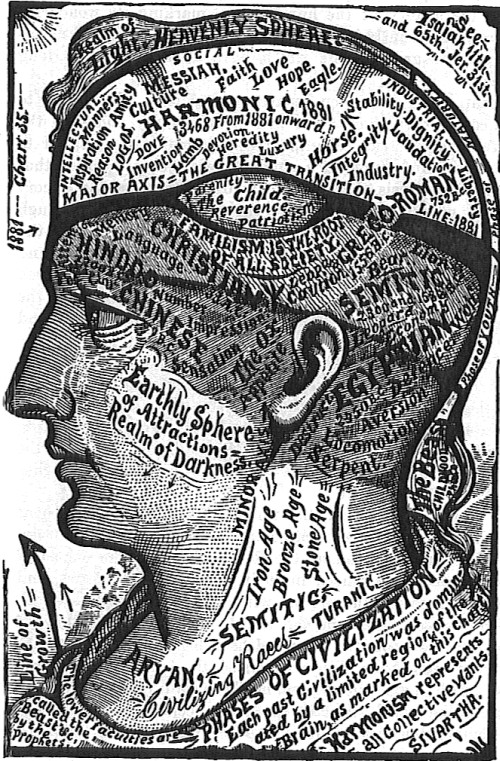
Comecei a papá-las e, bebericando,
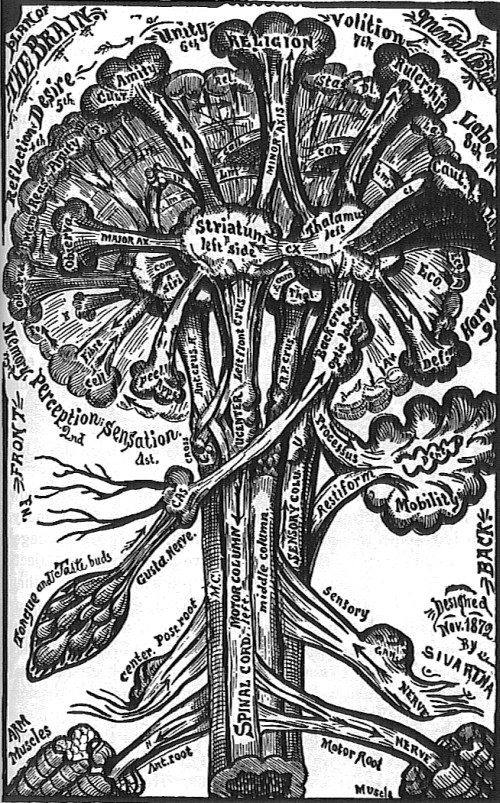
Assisti í  melhor cena que já vi neste ano.

– Vai dar uma de Dalton Trevisan agora?
Poupe-me, mini-pônei. Direto ao assunto!
– Quando as duas se acalmaram, eu me acalmei junto.
Foi então que o acusado fez um bota-fora
De livros muito bons. Um deles caiu-me aos pés.
Ao abri-lo, que surpresa! Trazia em seu bojo,
Do mestre, a assinatura que, em letras de estofo,
Reclama a propriedade. Meu olhar, de viés,
Insuspeito, mirou o alvo e, num salto esperto,
Dominei-o, em segundos, pelo flanco aberto.

A ruiva que há pouco gania que nem cadela,
Voa no meu pescocinho e leva um pescoção.
Algemo o tal Mulher e chamo o camburão,
Enquanto defenestro o namorado dela.
Pensei que ia ser linchado, mas chegou a tropa
E foi enfileirando os bebuns, no cacete.
Um senhor, bem vestido, rouba o capacete
De um guarda e, ao tentar sair de fino, topa
Com o Marreta, aquele negrão do terceiro
DPM, que lhe dá um pontapé no traseiro.

– Ui!, esse deve ter doí­do para caralho.
– O chute pegou saco, cu. Foi bem no meio
Das pernas. Levantou o cara do chão. Sei o
Quanto isso dói. Pro cara sentar, deu trabalho.
Mas prendemos a turma toda no quartel
E colocamos, um a um, sob investigação.
Vão ver o sol quadrado lá na detenção.
Nem a diarista gorda, que fez um escarcéu
Daqueles, escapou das garras do Marreta,
Que atordoou a velha com uma chapoleta.

Foi pipoqueiro, guardador-de-carro, não
Sobrou um pra contar a história lá no Largo.
– Belo trabalho, meu alazão! Café amargo
E uns dias na cela dão juí­zo e correção.
Agora, meu jumento preferido, diga
O que eu quero ouvir. Provas novas não há, certo?
O que temos de oásis em meio ao deserto
De idéias que esse departamento cultiva?
Desembucha, meu baio, não tenho o dia todo.
Solta a galope o rol de culpas desse povo.

– Encontramos, na bolsa da ruiva, maconha,
Um revólver com três cápsulas deflagradas,
E chaves. Como as portas não estão arrombadas,
Podem ter sido usadas pela sem-vergonha
Ou pelo assassino. Testes de baliza já
Estão em andamento, bem como os das chaves.
Burocracia e incompetência são entraves
Enormes. Agora só nos resta esperar.
Na casa do senhor de aspecto grave e sério,
Foi que demos de cara cââ?¬â?¢um grande mistério.

– Ah, foi lá que vocês encontraram a grana?
– Só verdinhas de cem. O pastor tem bom gosto.
– O quê, o cara é pastor? Na Universal tem posto?
– É um peixão pelo jeito. Mora em rua bacana,
Puta mansão, carrões, coleções de boa bebidas:
Vinhos, uí­sques, tequilas, runs, vodkas, absintos
E cachaças das boas, já bem envelhecidas
Nos barris de carvalho, em vários recintos.
A caixa de Blue Label está guardadinha
Para o senhor beber, na próxima festinha!

– Meu purí­ssimo-sangue da Arábia merece
Promoção! Que tal ser o meu braço direito?
– O esquerdo é que lhe falta. Não fosse o defeito,
O doutor já teria chegado í  Marrakesch
A nado. Superintendente da polí­cia é pouco,
Pra quem tem um Q.I. elevado como o seu.
– Ainda bem que tem quem reconheça que meu
Enorme potencial aqui é tratado a soco,
Pontapé e safanão. Relinche, que eu faço gosto,
De ouvir estas verdades assim: rosto a rosto.

– Ah! Chefinho, o senhor já entregou a bufunfa
à corregedoria? Cem mil dólares, Deus!,
O que eu não daria pra tê-los entre os dedos meus.
– Isso não lhe compete, comigo só triunfa
Quem não se mete í  besta e fica bem calado.
E pra você saber, as notas eram xerox,
Só cópias vagabundas. Tirei-as dos potes
E enviei ao Secretário, Dr. Paulo Furtado.
– Falsas? Aquelas notas? Eu não acredito!
– Pois pode acreditar. Se quiser, eu repito.

Mas chega desse assunto. O que mais conseguiu?
– Bem…tem algumas coisas, mas muito intrigantes.
Muito mesmo. A diarista já trabalhou antes
Com o Wilson e foi demitida em abril.
E foi bem problemática a demissão
Por justa causa. Temos que investigar fundo.
Parece que tem culpa no cartório, pois, junto
Com ela estava uma corrente de ouro, tão
Valiosa, que há queixa de roubo. E quem fez?
– O Wilson Martins, certo, meu bom bolonhês? (1)

– Muito bem, perspicácia é arma da polí­cia.
Mais comprometedor é que ela tinha cópias
De chaves em sua bolsa que parecem próprias
De uma mansão e não de um mocó de caliça.
Aí­ tem, viu, doutor!? A velha tem varizes
Até nos braços, pode um troço desses? Putz!
As rugas são tão fundas que não sei se há cútis
Sobre aquelas pelancas em forma de raí­zes.
O pipoqueiro é trinta e cinco anos mais moço,
Mas da fruta da velha chupa até o caroço!

– O que quer insinuar? Que esses dois são amantes?
– Não só são bons amantes, como também andam
Vendendo otras cositas que não são pipocas.
– Não vai querer dizer que os dois são traficantes?
– Sim. E de cocaí­na pura. O carrinho
De pipoca era só fachada para o tráfico.
Tudo muito bem feito. Tipo jogo rápido.
O pó era mocado dentro de um pacotinho
De sal. Os clientes tinham senha pra comprar
E pediam um salzinho extra pra levar.

– Mas como descobriu a ligação dos dois?
– A bela garçonete entregou a jogada.
O dono do bar era sócio da parada.
Disse que o pó corria solto logo depois
Que baixavam as portas e que só dá uns pegas,
não é viciada. Vou te contar, viu, doutor!?
O troço está de um jeito que eu não vejo por
Onde começar. Mas pode deixar cââ?¬â?¢o degas
Aqui, que vai dar tudo certo no final.
Se a gostosa cagar pra trás, vai levar pau.

Já transcrevi seu depoimento, se ela assina
Ou não é outro negócio. Tenho minhas dúvidas,
Pois choveu advogado a cântaros e as únicas
Testemunhas foram instruí­das na surdina.
Ã?â? raça fia da mãe! Parecem urubus
Vindo atrás de carniça, porra! Nunca vi
Coisa igual, me dá nojo. Tomem nos seu cus,
Filhos da puta! Pusilâmines! Daqui
Não sai ninguém até que me contem tudinho.
Tim-tim por tim-tim, muito bem explicadinho!

– Certí­ssimo, meu Apaloosa. Teu tropel (2)
Escreverá em ouro meu nome na história.
Até já posso ver as manchetes, a glória
Da capa na Tribuna, meu limite é o céu! (3)
Entrevistas, sessões de foto, imagine só:
Delegado Oliveira, o nosso Sherlok Holmes!,
Tomando toda a capa, sem ter outros nomes
Para ofuscar meu brilho. Cocoricocó!
Do espalhafato da galinha nasce a fama
Do ovo, e uma medalha meu peito reclama!

– Amado chefe, já o vejo lá nas alturas
E todos a seus pés, implorando atenção,
A chuva de convites, comemoração,
O carro aberto escoltado por cem viaturas!
Mas pra que isso se torne real, vamos í  luta.
O guardador de carros era o segurança
Do point, está sacando? Então a coisa avança.
Onde estão os bacanas? Quem será o batuta
Que comanda esses pés-de-chinelo da porra?
Café de primeira não se faz com a borra!

Sabe, doutor, de toda essa canalha aí­,
Se salva pouca coisa, mas vamos em frente.
– Chame O Mulher agora mesmo, tenho em mente
Que esse é o nosso homem. Vai, suma daqui!
Enquanto eu interrogo; você, meu Bretão, (4 )
Cavalgue em direção í s provas que preciso.
Esprema todos eles. Leve-os lá pro piso
Inferior. Faça suco de ossos e um sopão
Com os miúdos. A imprensa quer sempre notí­cia
Fresca, então, prepare a bomba mais propí­cia.

O que se segue todos sabem: o pau come
Solto pelo porão, corredores e salas
Da delegacia, onde arquivos, papéis, malas
E homens tentam chegar finalmente a um nome.
Depoimentos são lidos, relidos, refeitos,
Analisados, comparados, comentados,
Interpretados, investigados, jogados
Pra lá e pra cá, ficando ainda sujeitos
A novas aventuras nesse labirinto
De idéias e teses, que enlouquecem o recinto.

O governador quer resultados pra já;
O superitendente da polí­cia, pra ontem.
A imprensa? Bem, fabrica histórias de monte.
Maracujá ou comer cu de marajá
Tanto faz, quanto mais fictí­cio o estropí­cio
Melhor. Quem afinal quer saber da verdade?
A ficção é que vale, não a realidade.
Quem se importa se colocam no hospí­cio
O Mulher, aleijado por uma seção
De tortura total num pau-de-arara, ou não?

Quem se importa se fazem de mulher um homem
E lhe quebram as pernas para que confesse
O que fez e o que não? Quem rezaria uma prece
A quem chora de dor porque dez o comem?
Quem se incomodaria de sair de seu lar
E cobrar real justiça a um louco cabeludo,
Que atende pela alcunha de O Mulher, no mundo?
Quem cobraria a conta? Quem? Quem pagaria,
Conveniência e correção na mesma via?

Quem releria o capí­tulo sete de novo
Pra sentir o que é um Manicômio Judiciário?
Quem sentenciaria tudo que julgou inválido
E começaria de novo a contar com o ovo
No cu da galinha agora? Qual de nós, poetas,
Enforcaria seu canto pra dar dar vez e voz
A um zumbi entorpecido, vigiado por nós
Na camisa de força e mil gritos de alerta?
Quem, vendo-o babar, de olhos vazios no horizonte,
O chamaria de irmão com prazer de Anacreonte? (5 )

Mas deixemos, leitores, de lado o capí­tulo
Com suas cento e quarenta linhas mal rimadas,
Mil seiscentos e oitenta sí­labas contadas,
E um Wilson reluzindo bem no meio do tí­tulo.
Digamos que foi apenas mero desabafo
De alguém que foi lançado aos porões de um inferno
Em vida e quer fugir desse castigo eterno,
Com a poesia que tem debaixo do seu braço.
Afinal, um O Mulher a mais, um O Mulher
A menos, só faz diferença pra quem quer.

Você quer? Não? Então deixe cââ?¬â?¢o beque aqui.
Que eu vou fundo na história e, doa a quem doer,
Resolvo esse mistério, libertando, de uma vez
Por todas, inocentes e réus em poder
Dessa justiça cega, surda, muda e podre.
Estou bêbado? Louco? Claro. É bem óbvio.
Mas não assinei meu atestado de óbito
E quando ouço a palavra cultura, ao coldre,
Não levo a mão e, sim, ao coração, meu músculo
Maior, motor do espí­rito, juiz sempre justo!

(1, 2, 4) – Raças de cavalo
(3) – Jornal mais popular de Curitiba, focado em crimes e futebol.
(5) – Poeta, máximo representante da lí­rica jônica. Cantou os prazeres do conví­vio, do vinho e do amor.