Tactical Media in Brazil – Submidialogia conference report by Volker Grassmuck

publicado originalmente em waag sarai exchange platform
por Volker Grassmuck


December 29th, 2005

The four-day conference on the campus of the Universidade Estadual de Campinas (Unicamp) brought together many key persons from the tactical media movement of Brazil and some of their counterparts in the Brasilian government.

The movement is converging from roots in free radio, free software, hardware hacking, art and social movements. It is currently focussed around a large-scale project master-minded by Claudio Prado and supported by the Ministry of Culture: ââ?¬Ë?Pontos de Culturaââ?¬â?¢ (Culture Spots) which is aiming to empower up to 600 cultural projects with free software-based multimedia production and publication facilities.

One of the main purposes of the meeting, aside from taking stock of where the movement stands, was to discuss a proposal by the Sarai / Waag Exchange to set up a media center in Brazil as a new node in their exchange network.

There is a video documentation of the conference available. Transcripts of the discussions are currently being prepared. Submidialogia #2 is planned for October 2006 in Recife.

Mí­dia Tática started after a call in June 2002 from Next 5 Minutes to hold a tactical media lab in Latin America. Three Paulistas (Giseli Vasconcelos, Tatiana Wells and Ricardo Rosas) replied. A network formed bringing together various branches of of media research and practice, including media art, alternative journalism, a strong computer recycling movement and a free radio movement. Radio Muda located in the central tower of Unicamp having started in 1990, is the oldest and arguably the most influential of them, getting generations of students involved in media theory and practice, spreading the experience after their graduation to all parts of Brazil. Submidia / Radio Muda, namely activist Paulo Lara, was hosting the Submidialogia conference.

The call from the Netherlands resulted in a group of more than 300 people, mostly from São Paulo, working together to organise the first Tactical Media Lab (TML) in Latin America. It took place on a shoe-string budget in the alternative cultural space Casa das Rosas, on Paulista Avenue in São Paulo in March 2003. Under the theme of ââ?¬Ë?Digital Inclusion and Networked Communitiesââ?¬â?¢ it drew 6,000 participants and a strong echo in the press.

The TML was followed by three Autolab workshops in the suburbs of São Paulo. From January to July 2004 partly funded by Unesco, about 300 young people from the favelas were taught computers, web technologies, sound and video editing, all based on free software and recycled hardware. The Autolabs were concluded by two festivals: findEtático in November 2004 for discussing the experiences in the labs and in autonomous media production, and Digitofagia in October 2004, the largest festival on media, arts and technology so far that took place in Rio de Janeiro and São Paulo (at the Museum of Image and Sound), Recife, Salvador and Belo Horizonte.

In early 2003, the media movement really entered a new phase. One focal point bringing together diverse groups and communities was the TML, another one was Claudio Prado. The close friend of Minister of Culture Gilberto Gil, and his self-styled Coordinator of Digital Policy realised that something was going on with a strong free software movement and the arts and activism going digital. With the blessing of Gil he went around and approached many of the groups about a third generation digital inclusion project to be proposed to the Ministry of Culture under the name ââ?¬Ë?Pontos de Cultura.ââ?¬â?¢

What most of the world knows as ââ?¬Ë?digital divideââ?¬â?¢, in Brazil is reformulated as ââ?¬Ë?digital inclusion.ââ?¬â?¢ The first generation digital inclusion projects were about getting computers to the people. The second were about access to the Internet. A success story here are the Telecentros, free public Internet access centers running on GNU/Linux platforms, that were initiated by Sergio Amadeu, then working at the Governo Eletronico of São Paulo. The third generation according to Prado is now about empowering people to produce their own digital cultural expressions and share them with the world. Because the PMDB-run Ministry of Communications is trying to get any digital inclusion project under its wings, the Pontos de Cultura are not actually labeled as ââ?¬Ë?digital inclusionââ?¬â?¢ but as a ââ?¬Ë?cultural diffusionââ?¬â?¢ project. This is not the only reason why the term ââ?¬Ë?digital inclusionââ?¬â?¢ is disliked by everyone in the Mí­dia Tática movement. Another line of argument is: Felipe Fonseca, O fantasma da inclusão digital, Nov 20th, 2004

Based on the experience of the Autolabs, together with people like Alexandre Freire, then with the free software development group Arca, and visual communications people like Tatiana Wells and Ricardo Ruiz, Prado developed the project. There was an open call to cultural institutions and NGOs that could apply to become one of the Culture Spots. Schools, community centers, libraries, cities, samba schools, video groups etc. are all eligible to apply. When selected by a large advisory board under the auspicies of the Ministry of Culture, each of them receives a multimedia kit that includes a computer for editing, a server, photo and video cameras, microphones, a mixer, scanner and printer worth about 25,000 R$ (~9,000 ââ??¬). Along with it they receive a suite of free software programs for editing, serving and streaming. The core team is developing a series of workshops to teach the people at the Points how to recycle computers, how to operate the software environment, how to create websites, music and video in order to produce their own media content and distribute it. In addition, each Culture Point gets a budget of 5,000 R$ (~1,800 ââ??¬) per month over a period of two years.

The project team under the coordination of Freiere developed an online structure with five different platforms: Conversé, a Drupal-base open forum in wich the Points are exchanging their experiences, Estúdio Livre, a collection of links and context for free multimedia software, Xemelê, a repository for photographs, an internal server for mapping all the Points, and Cigar, a BitTorrent network for distributing the content that the Points produce that is currently being developed.

Claudio Prado reported at the conference that there are currently 85 people working for the project. Many of the ca. 50 participants at the conference are involved in it. Some like Thiago Novaes are employed directly at the Ministry. Others like Felipe Fonseca from MetaReciclagem work for the Information Technology Research Institute (IPTI), the formal interface between the Ministry and the grassroots movement. 270 Points were awarded in the first call. The plan was recently upped to make it look better in the election campaign next year, to 600 Points all together, incl. Points abroad (three in US, one in France, one in Tunis, more in Italy, one in Germany). Prado complained about much bureaucratic red tape that leads to a situation where it is always organisations with professionals who win public tenders. Therefore the board at the Ministry of Culture is disregarding formalities, looking at what the applicants are actually doing, and if selected, help them with the bureaucratic requirements.

Some of those selected to become a Culture Point were present at the Submidialogia conference, like Casa de Cultura Tainã where workshops on drum-making, drumming and other music are being taught to kids from the local community. There was also a small delegation from the Grupo de Trabalho Amazônico, Amazon Indians, living in remote villages, extracting rubber. They are collecting stories about every-day life, history, dreams, primarily to convey them to their children. Today they publish them as books. Once they have become a Culture Spot, they will also be able to make them available on the Internet.

The third generation of digital inclusion continues to be based on the previous two. The prime grassroots example for the first generation of getting computers to the people is the MetaReciclagem movement. Its founder Dalton Martins talked at the conference about his ideas on the three levels of approaching technology: from appropriating it as is via adapting it to tasks in a given reality to re-inventing it.

MetaReciclagem started in 2002. The groups get donations from banks and others companies that are renewing their PC pool. They refurbish these machines for use in social projects like Telecentros, and, more important, teach people how to do this themselves.

It turned out that it is easiest to get donations in the South-East of Brazil. Dalton is therefore planning to establish an exchange network for parts so initiatives in other locations can ask for network cards, harddiks, keyboards etc. and have them send from groups that have them. He sees selling refurbished computers as a possible business model for the Pontos de Cultura. Dalton does not see it as a problem if companies take up the recycling concept in order to make money with it. It only strengthens the network.

A top-down approach to the access-to-computers issue that recently made waves is the $100 laptop project by MIT MediaLab. Brazil committed itself to buying two million of those, but the project was not discussed at the conference.

The Telecentros are a successful approach to the second generation digital inclusion, the issue of access to the Internet. Today there are 120 Telecentros in São Paulo and some in other parts of Brazil, typically located in favelas in big cities. In order to reach people in the poor rural areas especially in the North and North-East of Brazil and in remote places e.g. in Amazonia, the Ministry of Communications initiated the program GESAC (Governo Eletrônico – Serviço de Atendimento ao Cidadão – Electronic Government – Service of Attendance to the Citizen). Its goal it to provide up to 5,000 points of satellite access.

At the conference, Antônio Albuquerque reported on the project. He had been with the Ministry of Communications since November 2002, and was Director of Services of Digital Inclusion of the Secretariat of Telecommunications and head of GESAC since January 2005. He was the last official from PT inside the ministry before he was fired in August 2005.

The ministry sees it as a connectivity service which should include tele-education and be rooted in the local community. On GESAC it is working together with the ministries for education, strategic planning and defense.

In October 2002, the contract for implementing the first phase was awared to Gilat, a company that provides telecommunications solutions based on Very Small Aperture Terminal (VSAT) satellites. Albuquerque said that in 2003 there was a five-months struggle inside the ministry until June when the project finally got started. Gilat established 3,200 sites, 2,200 of which are in schools. Others connect institutions ranging from NGOs via public buildings to military bases in the Amazon. Currently the public tender for the second phase has been issued. Albuquerque feared that if the Minister of Communications changes again, GESAC might get trashed.

While GESAC and Pontos de Cultra are projects from competing ministries, there are links between them. Some of the people in the Mí­dia Tática movement are working for GESAC, like Tatiana Wells who helped establish stattlite-connected telecentros is the Northern states of Piauí­ and Natal. Some of the Culture Points might get access through the GESAC network.

Another project of the Ministry of Communications is the digitisation of TV and radio. It seems that everything digital in Brazil, indcluding these undertakings, is supposed to interconnect with all the other digital inclusion projects.

At Submidialogia, Takashi Tomei from CPqD Telecom & IT Solutions, the company that manages the Digital TV project for the Ministry of Communications was presenting the current state of discussion. So was Claudio Prado who is on the project team, doing his best to have the whole digital TV infrastructure implemented in free software.

The current Minister of Communcations, Hélio Costa, the third in two years, affiliated with the media empire Globo, used to be a newscaster during the dictatorship, then lived in N.Y., is driving the digitisation of televitsion and radio, but without any public debate, and favoring the US American standard. The US vision is HDTV for big screens in home theaters. But, asked Tomei, is that really appropriate for the Brasilian reality? He would rather see the digitisation of the electromagnetic spectrum used in order to increase the number of channels.

In the digital radio project, again the US American format was approved. Standardization of DAB technology is promoted by the World DAB Forum, which represents more than 30 countries excluding the United States which has opted for its own system. It uses a bandwidth of 400 kHz for both analog and digital channels. But, criticised Tomei, when the analog service is switched off in a few years, the channels will still be 400 kHz wide rather than the 200 kHz of the alternative standard, which will be limitting the number of stations.

Copyright was another issue at the conference, raised by lawyers who advise the media activists and by artists who are trying alternative licensing like Creative Commons or take a rather playful stance towards intellectual property.

Caio Mariano from the law firm KFC Advogados in São Paulo has developed an open content license for Re:combo, a collective of musicians, software developers, DJs, teachers, journalists and artists set up in 2001. They use sampling and peertopeer software as a means of expression through software, installations and live events. The group has about 40 members, spread throughout Brazil but also abroad, with a high concentration in Recife. The work of Re:combo is guided by the three principles of a) encouragement of ââ?¬Ë?intellectual generosityââ?¬â?¢ b) the redefinition of the role of the artist within industry, and c) a dialogue with the audience as the creative agent for the work. The need for a licence in the copyleft spirit of the GNU GPL and suitable for the use in audiovisual production was felt from the beginning. After a series of studies, the collective and lawyer Mariano together developed the “Licença de Uso Completo Re:combo” or LUCR (Re:combo Complete Use Licence) published in August 2003. It expresses Re:comboââ?¬â?¢s idea of intellectual generosity, rather than intellectual property. It is more radical than Creative Commons in that it does not give authors the option to exclude commercial use.

Mariano works closely together with Ronaldo Lemos who is director of the Center for Technology & Society at the Law School of the private university Fundação Getulio Vargas in Rio de Janeiro and project lead Creative Commons Brazil. Lemos was not able to attend the conference.

OrganismoBR is another diverse collective similar to Re:combo. Glerm Soares presented their work at Submidialogia. Activities include video, web-art, photography, music (among others by the band Matema and the Printer�s Orchestra) and publications, many of which are issued under the names Vitoriamario and Apodrece. Vitoriamario, a collective personality composed of several hundred persons, kind of a Luther Blisset, was active during 13 years before he announced his suicide in 1999. In his decomposing state, Vitoriamario, now also called Apodrece, became free for appropriation by the next generation of communications guerilla, issuing manifestos, proposing a new global currency and denouncing all property.

The anti-copyright plagiarist publishing collective Sabotagem was presented by Dr. Gorilla from Recife. The group was founded in 2002, has about ten members, and puts books and texts by authors like Foucault and Chomsky online, which are essential reading for a critical media discours.

The fourth day of the conference was dedicated to the state of media art in Brazil. Especially the system of art funding by foundations of the oil, telecommunications and banking industry, and funding through tax incentives was questioned.

Ricardo Rosas, the founder of Rizoma.net lamented the crisis of media art that he characterized as apathy and paralysis, not getting involved with social issues. He reported that the panel on the crisis of media art at the Digitofagia event drew the largest crowd, concluding that there is strong interest in the question.

Giseli Vasconcelos, who after co-founding Mí­dia Tática moved back to here native town of Belem in the North, complained that the art world is strongly centered in São Paulo, and that art from the North can only be sold through the galeries in São Paulo.

Artist Lucas Bambozzi belongs to C.O.B.A.I.A., a group formed during a squat with 3,000 people in São Paulo in November 2003 where artists joined hands with people from the landless peopleââ?¬â?¢s movement MST (Movimento dos Trabalhadores Rurais Sem Terra). The purpose of C.O.B.A.I.A., according to Bambozzi, is to interfer with reality. He presented a number of projects, including CUBE, a large interactive multimedia installation that seven groups errected on a square on Av. Paulista in São Paulo. The translucent walls of the cube were projected onto from the inside. Various DJs and VJs were participating in the event. People with wireless microphones involved passers-by. The cube created a disturbance in public space. At first there was irritation, but soon people played along, and it turned into a big happening.

Fabianne Borges, is from the group Catadores de Histórias (history collectors), collecting stories from people in the streets, an idea that now has been taken up by the Ministry of Health. Borges also had been involved in the huge São Paulo squat. She told the conference that coordination among that many people was not a problem. The economics worked out well. There was a free university inside the squat. But at the end everybody was fighting and the group split. They met again this year and formed the ââ?¬Ë?group without property.ââ?¬â?¢
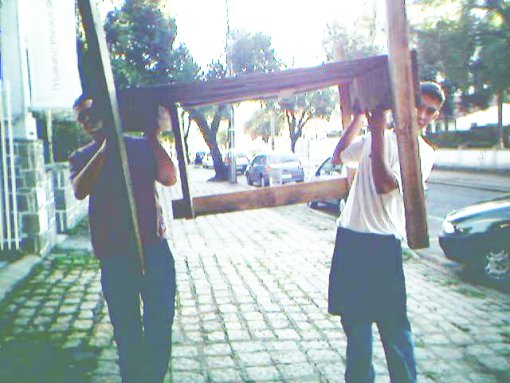

A Mesa / “Curitiba não tem príncipe / A burguesia de Curitiba não conhece Curitiba / Quem conhece Curitiba come lixo” (Pastor Robinson)

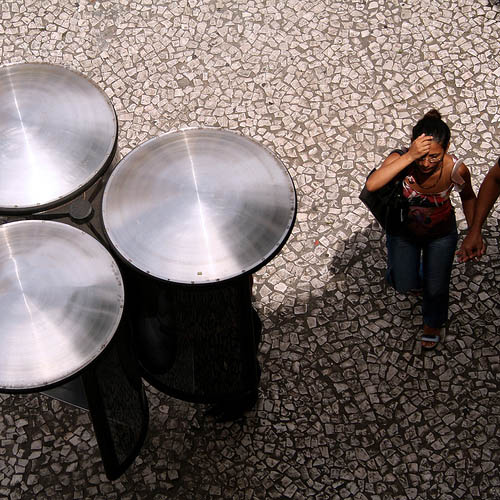
Moving ST table from Ybakatu to Beto Batata. The “tische”, made out of waste materials offered to the “cicle circuit” of the city and cart collectors, may generate some other cooking actions at a new address.
Transporte da mesa construida para o evento “Surface Tension – Curitiba” na Galeria Ybakatu. A Mesa, feita a partir de materiais encontrados na rua na região do Alto da XV, segue seu ciclo de ações culinárias “Cozinhando com Puros Dados” no Beto Batata, na rua Professor Brandão, 678

www.errantbodies.org

Cooking Pure Data: Blenders and Electric-Appliances for Collective Modelling

Working with the formation of a group open to any kind of participation, mediated only by the intersection of social and aesthetic searches, whose actions develop according to the convergence of collective networks (mainly by Internet), the “Orquestra Organismo” group has a way of production where the process of “molding speeches” is taken from the beginning as the real “object” to be generated. Group work is the “product of actions modulating through time” where the intentions of interacting individuals (as well as their function as catalysts of relational dynamics) are the object “on scene”, operating as a live search for equilibrium between group performance and individual being (beyond any artistic or social analysis). Pieces are interactively built and sculpted through processes that foster a mutation of meanings produced through actions that seek to function as part of a space molded by institutionalizations like “music”, “theater”, “film”, “galleries”, “bar”, “home” or “streets”; while always reinforcing the lucid situation that stimulated human relationships than all those generated as “objects” or “signs”.

The purpose of “Cooking Pure Data” should be seen as a continuation of Orquestra Organismo and their most recent performances – “Desafiatlux” and “A justa Razao aqui Delira” – and has its genesis in the actions of “Surface Tension_Curitiba”. These ideas stem from recognizing that we live in an age of overloaded information and possibilities of connection over networks formed by shared speech that is beyond territorial and linguistics borders. On the other hand, the Cartesian and systematic organization of this DATA tends to be dissolved into the space where it takes form by institutionalized functions (from arts to engineering; from activism to social theory). Nevertheless, those flowing identities are touched by subjectivity before they lose strength – through this process of intervening within such functions and spaces they will produce contradictions even while acquiring an “institutional” meaning. Our effort is for all “DATA-processed-speeches” to be perceived as a chaotic dance of entities, sculpted into symbolic rituals, “cruelty theaters” and aesthetics of direct action, leading forms of practice and ethics to an immediate perception of human dimension. This is the ambition of making projects.

In “Cooking Pure Data” we work in the kitchen of the exhibition space, which will be connected to other participants through Internet anywhere in the planet. The kitchen functions to incubate the anthropological concept of the “Raw and Cooked” worked out by Lí¨vi-Strauss: the creation of ritual processes that marks the dialogic way in which “raw” DATA that at first is without “function” becomes able to assume (at the end of the meeting) various meanings, as long it helps to converge the intention of multiple “cooks”. The kitchen should be emphasized as a space where we always get together in rituals of “feeding” (and all our processes are about “feedback”). Using this meaning, we aim to build a metaphor of the kitchen as a space of alchemy where dialetics boils the collectivist intentions and the “starvation” (or gluttony) is the anxiety that brings us back to the human dimension.

Plans for staging events:

1. The installation should be built in the kitchen of the exhibition place, with drafts, drawings, annotations, personal audio/video recordings, mainly objects brought from “home”, included as participants, the organizers and visitors who wish to interact. This has to be done without turning the kitchen into a “gallery”, the focus rather is to collect material so as to generate “DATA cooking”. This procedure may transform the kitchen into a common space for the participants, for informal meetings that will facilitate bringing them to a “temporary autonomous zone” inside the space where data are “boiled”.

2. Simultaneously to the place of exhibition, we intend to articulate similar structures in various cities of Brazil: Curitiba, Belo Horizonte, Sao Paulo, Rio de Janeiro, Salvador, Campinas, Belem, Porto Alegre, Recife, Brasilia and Florianopolis, and possibly cities in other countries. This action will be scheduled over Internet, being sensitive to its process of articulation as an important part of the “data recipe” scope.

3. Deconstructing the perception of “home”, we will make music with electric appliances such as blenders, vacuum cleaners, fans, multiprocessors and others that should be painted as a canvas and covered with diagrams, annotations, poetry and impressions about the actions. The appliances should be traded between places to reside in different kitchens. These appliances will be controlled by participants remotely through a website.

4. Cooking “Rituals” will be scheduled at the same time, where participants prepare food as the action is recorded on video, sound media, drawings, and streamed through Internet, interacting with people doing whatever they want in the space, recombining feedbacks of data from other kitchens at the same time. This “feed-back” and mirroring of data will cause the sensation of simultaneous presence and the kitchens will become a place passing through geographic borders taking the repertoires as a common database for reality constructions. This will influence direct action and relationships through the network. The processes caused by the “kitchen” should also be registered and reprocessed in new rituals and future ideas.

5. Season as you like and put it in the stove.

6. We stimulate the rhythmic use of the kitchen, spoken words, musicalization of cooking acts. We ask for the use of different languages and accents as you cook this data. After the dinner, one should digest the data and expend the consequent energy through direct actions in the streets.

Glerm Soares – January 2006

“Na maior cratera
Tu mescles do mais puro e aprontes copos;
Carí­ssimos varões meu teto acolhe.”
O camarada obedeceu contente.
Ele, ante o lar, em cúpreo largo disco
Dorso depôs de ovelha e gorda cabra
E de um cevado os suculentos lombos:
Automedon segura, o herói perito
Em pessoa esposteja, enrosca e espeta;
O Menécio deiforme atiça o fogo:
Lânguida a flama, ao rúbido brasido
Sobre as lareiras os espetos vira,
De sal tempera-os sacro; todo assado
Põe da cozinha í  mesa, e o pão ministra
Em lindos canistréis. Do ítaco em face
Toma a parede e as carnes trincha Aquiles;
O sacrifí­cio incumbe ao companheiro,
Que ao fogo atira as divinais primí­cias.
Deitam mãos dos manjares os convivas.

Súbito sacrifica branca ovelha:
Esfolam-na, esquartejam-na, e a preceito
Assam de espeto no brasido as postas;
Em canistréis na mesa o pão reparte
Automedon, e Aquiles trincha as carnes.
às viandas se deitam; e saciados,
Prí­amo admira o talhe do Pelides
E a divina beleza, admira Aquiles
A facúndia e presença do Dardânio.

Spectrenoise intona rumori! – não é bossa noÃ?â??oÃ?â?? va mais é muito naturaLLLLL….

SURF ATONAL
(Marcelo Birck)
perguntem í s garotas que se amarram em mim / por quê o meu estilo é
dissonante assim / estou ligado e nem penso em me desconectar
de um ritmo que é algo mais que transcendental / não queira me dizer que eu
estou fora de tom / escandalizem – se os quadrados, para mim tá muito bom/

se alguém vem me falar que está errado deste jeito / eu digo está desafinado e
para mim não é defeito / pois quero ver as notas fora de lugar / mesmo
sabendo que nem todo mundo vai assimilar / este surf atonal, é o surf atonal /
que não é bossa nova mas é muito natural /

sigo em meu caminho e para mim tá tudo bem / não vou me ligar em
mexerico de ninguém / pois tá na hora mudar de filosofia / manter o
pensamento alerta em plena sintonia

olho vejo bem, sigo contente feliz / sempre ignorando o aviso que diz /
que as notas tem que estar neste ou naquele lugar / estou ligado e nem penso
em desconectar / deste batuque infernal, que é transcendental /
garotas abram alas que agora eu vou decolar / neste surf atonal, é um surf
atonal / que não é bossa nova mas é muito natural / Hei hei / surf atonal , surf
atonal, etc……

Yamatsuka Eye fu per diversi anni il leader e cantante degli Hanatarashi, formazione radicale di rumore alla Einsterzunde Neubaten della quale uscirono tre album senza titolo (nel 1985, 1987 e 1990) e, postumi, un paio di live. Poi si uni` al chitarrista Seiichi Yamamoto e formo` i

Boredoms.

Il loro programma di uno stile ibrido dadaista di speedmetal e free jazz venne definendosi attraverso numerose cassette autoprodotte, fra cui le tre Boretronix, Yellow Power Scum e Journey Into Pain.

I Boredoms esordirono come trio di punkrock sull’EP Anal By Anal (Trans, 1986), con Anal Eater e Born To Anal, praticamente un tour de force vocale di Eye. L’album Osoresan no Stooges Kyo (Selfish, 1988) rafforzo` l’oltraggio ai canoni musicali e alla decenza morale (Feedbackfuck). E` gia` evidente la propensione per l’anarchia completa, ma il complesso tenta ancora di suonare come un complesso e il cantante e` un cantante. I due dischi verranno riediti su Onanie Bomb Meets The Sex Pistols (WB, 1994).

Dopo il singolo Michidai (Public Bath) il sestetto venne rivelato alle masse americane dall’album Soul Discharge (Shimmy Disc, 1989), in cui molti riconobbero le armonie cervellotiche di Can e Faust, soprattutto il rumore assolutamente anarchico dei secondi; ma invece dell’opprimente senso di tragedia dei Mnemonists alla fine rimane un bonario tono da folletti.
La loro e` spesso una musica di mutazioni frenetiche, dove la sorpresa e il trauma contano piu` della sostanza. Il Jimi Hendrix in versione “industriale” di Bubblebop Shot degenera in una coda grandiosa in cui sono sovrapposti una rauca cantante di rhythm and blues, un uomo che strilla i propri guai e un baccanale casuale degli strumenti. 52 Boredoms parte nel segno del techno piu` scipito, ma precipita poi in un sabba sfrenato nel quale si alternano voci sempre piu` invasate e strumenti sempre piu` fuori misura. Il devastante Pow Wow Now ha mille e mille ripensamenti, divagazioni, pause, incidentali. Ciascuno strumento e ciascuna voce viene usata al limite delle sue possibilita` sonore. Ogni brano e` un accumulo di eccessi gratuiti.
Cio` che e` cambiato soprattutto rispetto al passato sono le parti vocali: ogni membro emette rumori striduli, cercando di rubare il tempo agli altri. Il loro e` un vocalismo demenziale fatto di gargarismi, gorgheggi, solfeggi, pernacchie, un’arte tutta trasgressiva che pero`, in assenza di un ritmo o di un riff o di una melodia che siano tali, diventa il motore dei brani. Z&U&T&A fa pensare a una tribu` di indiani sbronzi che danza fino a sfiancarsi, e Pussy Badsmell a un’orgia di qualche girone infernale nel caos strumentale piu` totale e frastornate. Se i Boredoms non sono i primi a sperimentare con la voce, sono fra i primi a tentare un’arte di armonie vocali dissonanti. Fra i numeri piu` riusciti va annoverato anche per l’assolo d’antologia di TV Scorpion.

Pop Tatari (Reprise, 1992) ha continuato sulla stessa falsariga ma forse con maggior cognizione di causa, che, nel caso loro, non e` necessariamente un complimento. In Hey Bore Hey e Bocabola la loro arte di strilli e dissonanze a ritmo omicida e` ancora in primo piano. L’opera, frammentata in diciassette brani, perde pero` qualcosa dell’impatto violentissimo del lavoro precedente. Le lunghe suite senza capo ne` coda di Bo Go, Cheeba e Cory And The Mandara Suicide Pyramid Action costituiscono al tempo stesso il vertice del loro dadaismo e il punto in cui la sua irrazionalita` comincia a ritorcersi contro di loro.

Wow 2 (Avant, 1993) annovera brani piu` compiutamente rock come jet Net e Rat Soup, e costituisce tutto sommato un’eccezione, non una transizione.

Il concept auto-referenziale Chocolate Synthesizer (Reprise, 1994) e` un altro monumento di dadaismo sfrenato, un carnevale di travestimenti piu` che un disco di musica. L’esorcismo tribale di Acid Police sarebbe piaciuto a David Peel, La fanfara mostruosa di Shock City, I demenziali solfeggi yodel e l’isteria cannibalesca di Tomato Synthesizer e Anarchy In The UKK, il garage-rock rocambolesco di Mama Brain e Turn Table Boredoms, il blues sgangherato di Actions Synthesizer Hero, l’inno di Uoredoms, naturalmente subito tempestato di botte chitarristiche e percussive, la danza rituale di B For Boredoms, il free-jazz ridicolo di Eeedoms… le opere dei Residents, al confronto, sono dei capolavori di razionalita`.

I sette EP intitolati Super Roots contengono numerose jam improvvisate dal vivo e sono consigliate soltanto ai fan piu` tenaci. Il primo contiene forse le piu` spassose, come Budokan Tape Try. La quinta contiene un brano di un’ora, Go.

Eye e` anche attivo negli Ufo Or Die, titolari di Cassettetape Superstar (Time Bomb, 1993), un disco ispirato dai Fugs, negli Audio Sports di Era Of Glittering Glass (All Access, 1992), negli Electric Teeth e negli Elvis Dust, tutti complessi piu` o meno dediti a musica fortemente sperimentale, e collabora ai Naked City di John Zorn, con il quale ha registrato sotto diversi pseudonimi Nani Nani (Tzadik, 1995) e Zohar (Tzadik, 1995).

Il chitarrista Seiichi Yamamoto ha formato anche gli Omoide Hatoba, che hanno registrato Daiongaku (Alchemy, 1990), Suichu Joe (Alchemy, 1991), Black Hawaii (Alchemy, 1992), forse il piu` accessibile, Mantako (Public Bath, 1994), Kinsei (Meldac, 1995), forse il piu` geniale, grazie al contributo della tromba e della tuba, Vuoy (Polystar, 1997), forse il meno interessante, opere altrettanto radicali, soprattutto quando si aggregano personaggi come KK Null o Keiji Haino.

Dal canto suo il bassista Hira (o Hilah) canta per gli Hanadensha.

Hanatarashi ha pubblicato altri due dischi, 4 (Public Bath, 1994) 5 (Shock City, 1996), il primo un collage di trentatre demenzialissimi brani e il secondo un unico lungo brano elettronico di 50 minuti.

Nell’arco dell’intera storia del rock pochi hanno osato stravolgere il concetto di armonia come i Boredoms, pochi hanno rinnegato in maniera altrettanto radicale i concetti di ritmo e di melodia, pochi sono riusciti a comporre brani cosi` privi di una trama. Il loro contributo piu` importante rimarra` probabilmente nel campo del canto, dove hanno esteso le intuizioni di David Thomas e Captain Beefheart, congegnando contrappunti fra voci che non sono piu` voci ma semplici aberrazioni di voci.

Super aR (Birdman, 1999) sono i Red Crayola che incontrano i Faust mentre Lou Reed suona la sua Metal Machine Music in sottofondo. Inoltre, l’incarnazione musicale clownesca di Eye trasforma spesso esperimenti quali Super You e Super Coming in fumetti perversi. Le composizioni serie costituiscono il progressive rock piu` irrazionale e capriccioso mai documentato su disco.

Vision Creation Newsun (Warner Bros, 2000) e` una suite in nove movimenti che incarna gli sforzi dei Boredoms per scoraggiare gli ascoltatori.

Originally influenced by the sounds of European bands like Whitehouse, Japanese style noise music then pushed this approach to an extreme of loudness and density, which in turn became a major influence on western noise bands. Sometimes known as “Japanoise” (not just as a pun in English, but even in Japanese: ãâ??¸ãÆ?£ãÆ?â??ãÆ?Žãâ??¤ãâ??º ), it is usually associated with “harsh” characteristics including walls of white noise, non-linear pulses, beats, sampled loops, dialogue, and sirens. Since the late 1980’s this Japanese style has been probably the most prolific and noticeable part of the Noise Music scene. Thus in magazines and the popular imagination the term Noise Music is often closely associated with this style. Likewise the popularity and prolific output of musicians such as the aforementioned Noise Music figurehead/posterboy Merzbow, Otomo Yoshihide and other names like KK Null, Masonna, The Gerogerigegege and Hanatarash (founded by Boredoms frontman, Yamatsuka Eye) have made Japan something of a Mecca for many noise fans. In terms of sales, Noise music is not particularly more popular in Japan than in Europe or America. However, there is perhaps a higher level of recognition from crossover with mainstream genres and events, such as fashion shows or dance performances with music by noise artists, and a comparitively large number of noise live performances are held in Tokyo.

Also, in more recent years, the onkyo style of noise/free improv is becoming more prevalent in Japan. Centered around the Off Site club in Tokyo, and including artists such as Sachiko M, Otomo Yoshihide, Toshimaru Nakamura, Shigeru Kan-no and Taku Sugimoto, it is a form of electro-acoustic improv that focuses on quiet, pure tones, static and space. As with most genre descriptors, there is a backlash against the term, feeling that it solidifies the style into a fixed form (obviously the death knell for any free improv), but for now, it serves as a simple way to convey the general style of modern Japanese improvisational music

Enxofre!

O universo não existe. É tudo invenção. A dor é o prazer. Matar é o Ato da Criação.

palavrasnúmerospalavrasnúmerospalavrasnúmerospalavrasnúmerospalavrasnúmeros
palavrasnúmerospalavrasnúmerospalavrasnúmerosJulGaRouJoGaR:


Onofre!
Enxofre!

Também obrigou a todos, pequenos e grandes, ricos e pobres, livres e escravos, a receberem certa marca na mão direita ou em seu rosto,
para que ninguém pudesse comprar nem vender coisa alguma, a não ser que tivesse a marca, que é o nome da besta ou o número do seu nome.
Aqui há sabedoria. Aquele que tem entendimento, calcule o número da besta, pois é número de homem. Seu número é seiscentos e sessenta e seis.
Apocalipse 13:16

JulGaRouJoGaR:
JulGaRouJoGaR:
JulGaRouJoGaR: ou não? ou não. ou não!

880volts

Gekritzel [gÃ?â?¢’kritsÃ?â?¢l] n(-s;0) gatafunhos m/pl., rabiscos m/pl., garatujas f/pl.
:
: (x,y.z) -v- (x,y,z)

The Anti Oedipus ( O Anti Édipo )

âõí¥ Ã?â?í·Âí·üâí·ê Ã?Ë?Ã?â?¢í¹Â Ã?â?¢í¸í¨í¸â

The fruit of the Tree of Knowledge of Good and Evil (Hebrew: âõí¥ Ã?â?í·Âí·üâí·ê Ã?Ë?Ã?â?¢í¹Â Ã?â?¢í¸í¨í¸â) will throw our hero to a deterritorialization field and a possibility of a life beyond Eden.
—————————— ———–
O fruto da árvore do conhecimento levará nosso herói pelo campo da desterritorialização e possibilidade de um mundo além do Éden.
—————————— —————
P&B, 1 minuto, Brasil 2001 – mpg
—————————— —————
by Vitoriamario ( copyleft – modelo Atribuição-Uso Não-Comercial 2.5 Creative Commons)
Creative Commons License

Direção: Rodrigo Soares e Daniel Bittencourt
Roteiro: Glerm Soares
Elenco: Adriano Peterman, Alan Raffo, Candice Di e Tuca Fanchim
Câmera: Daniel Bittencourt
Edição: Rodrigo Soares

+ sobre VITORIAMARIO
Apodrece e vira aduboQuando surgiu Vitoriamario?

Vitoriamario – O primeiro registro de vitoriamario data dos pré socráticos, alias o próprio Sócrates, foi uma brincadeira inventada por ele. Na época vitoriamario morava em uma comunidade dioní­sica fundada numa ilha do mar adriático que já possuia seu próprio panteão de í­dolos todos chamados sócrates, uma piada interna entre eles para caçoar do folclore de seus conteranêos que há tempos havia se tornado motivo para distrair o povo grego dos despotas esclarecidos de Atenas. Por isso Sócrates não deixou escritos pois foi uma piada dos vitoriamario pré-socráticos, assim como Jesus foi um apelido para Pedro, João e outros 10. O secreto Vitoriamario hebreu verdadeiro mentor do discurso cristão que acabou deturpado em Roma. Vitoriamario é um apelido elitizado, uma espécie de seita secreta racionalista que tem sobrevevido há gerações. Resolvi adotar sua alcunha em homenagem ao Vitoriamario que lutou na Guerra do Contestado aqui em meu território, se bem que ele era mais um cancioneiro do que um soldado… Já pelo viés da arqueologia o primeiro vestí­gio de vitoriamário foi encontrado por um nativo no Morro do Sabão (Ilha do Mel-PR) em 1805, na rocha dizeres em lí­ngua nativa e desenhos eróticos de grandes sacanagens tribais. Muitas pessoas acham que o morro seja amaldiçoado pela fúria de Vitoriamario, devido ao alto í­ndice de acidentes ocorridos por lá. Mais recentes são as apresentações multi-sensoriais que um grupo de artistas nômades realizam a pelo menos 12 anos, usando desde instrumentos eletroacústicos tradicionais, como captadores com bobinas enroladas ao viés, Banjolin (espécie de violão aspirador de pó), ventiladores gigantes, aceleradores de particulas sonoras, dodecaedros e mutilações… Bem, tem muita coisa sobre ele em meu site, mais não é motivo para reverências, ele está morto e hoje Vitoriamario sou eu… ou você, o que importa?
leia mais aqui..

Loteria Nacional

National Lottery – video do mestre e amigo Marcelo Borges.

homenagem a canalhada que orbita a bolha da ilusao de liberdade ,e que se alimenta da sujeira que so a ode ao voto obrigatorio acumula.

Acesse a Página do Marcelo Borges no you tube e conheça um acervo único da filmografia do rock independente de Curitiba, além dos clássicos curtas e videoinstalações do figura.

Na Casa da Claudete

Casa da Claudete (para Claudete Pereira Jorge, Octávio Camargo, Luiz Felipe Leprevost e todos que frequentam a casa da Claudete)

na casa da Claudete
os cristos são descrucificados.
religiões são formadas,
reformadas e destruí­das.
legiões e batalhões de idéias
são postas em sentido em versos
conservados em vodka.

na casa da Claudete
o marxismo também é tomado com coca-cola
o stalinismo cuspido pra fora da janela
e homero lido a marteladas
de mais ou menos 5.000 palavras.

na casa da Claudete
o incrí­vel Hulk é um adorável covarde
o jantar é a luz de velas pela falta de pagamento
os mestres são amigos do peito
que carinhosamente
mandamos para aquele lugar.

na casa da Claudete
um uno mil pára no meio do caminho
e í  pé buscamos o combustí­vel
num posto da rua de baixo.
lá não se cala a boca, se fala mais alto.
lá, adormecer é um ato de revolta.
é uma pausa para a volta triunfal.

“aliás, a casa dela
definitivamente não é a minha”
foi o que eu pensei
a última vez que adormeci
num dos cantos
da casa da Claudete.

alexandre frança

quer mais? entre no blog Blues Curitibano e confira as novidades.

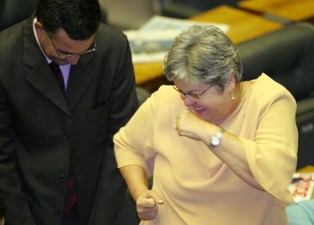
A dança dos vampiros

angela-guadagnin
Clique na imagem para ver o ví­deo de Ângela Guadagnin (PT-SP) comemorando a absolvição, pelo plenário da Câmara, de João Magno (PT-MG) das acusações de recebimento de mensalão.

dep.angelaguadagnin@camara.gov.br

porcada2

O Futurismo Italiano (Carta de GRAMSCI a TROTSKY)

Eis aqui as respostas í s perguntas que você me fez sobre o futurismo italiano: O movimento futurista, na Itália, perdeu, completamente, seus traços caracterí­sticos, depois da guerra. Marinetti dedica-se muito pouco com o movimento. Casou-se e prefere consagrar sua energia í  esposa. Monarquistas, comunistas, republicanos e fascistas participam, atualmente, do movimento futurista. Em Milão, onde, recentemente, se fundou um semanário polí­tico, Il Principe, que formula, ou procura formular, as teorias desenvolvidas por Maquiavel para a Itália do século XV, a saber: Só um monarca absoluto, um novo César Bórgia, colocando-se í  frente dos grupos rivais, pode encerrar a luta, que divide os partidos locais e leva a nação ao caos. Dois futuristas, Bruno Corra e Enrico Settimelli, dirigem o órgão. Marinetti colabora hoje nesse periódico, embora tivesse sido preso por causa de violento discurso contra o rei, que pronunciou em 1920, durante manifestação patriótica, em Roma. Os principais porta-vozes do futurismo de antes da guerra tornaram-se fascistas, í  exceção de Giovanni Papini, que se converteu ao catolicismo e escreveu uma história do Cristo. Os futuristas, durante a guerra, foram os mais tenazes partidários da “luta até a vitória final” e do imperialismo. Só um fascista, Aldo Palazzeschi, declarou-se contra a guerra. Rompeu com o movimento e terminou emudecendo como escritor, embora fosse dos mais inteligentes. Marinetti publicou um manifesto para demonstrar que a guerra – sempre, aliás, exaltada por ele – constituí­a o único remédio higiênico para o universo. Tomou parte no conflito como capitão de um batalhão de carros blindados, aos quais teceu um hino entusiasta no seu último livro, A Alcova de Aço. Escreveu também uma brochura intitulada Fora do Comunismo, na qual desenvolve suas doutrinas polí­ticas – se se pode qualificar de doutrina as fantasias desse homem – que são por vezes espirituosas e sempre estranhas. A seção de Turim do Proletkult, antes da minha partida da Itália, pediu a Marinetti que explicasse, na abertura de uma exposição de quadros futuristas, o sentido do movimento aos operários. Ele aceitou, voluntariamente, o convite. Visitou a exposição com os operários e declarou-se satisfeito com o fato de demonstrarem mais sensibilidade que os burgueses no que concerne í  arte futurista. O futurismo, antes da guerra, era muito popular entre os operários. A revista L’Acerbo tinha uma tiragem que atingia a 20.000 exemplares, dos quais quatro quintos circulavam entre operários. Quando de numerosas manifestações de arte futurista, nos teatros das maiores cidades italianas, os operários defendiam os futuristas contra os jovens – semiaristocratas e burgueses – que os atacavam. O grupo futurista de Marinetti não existe mais. Um certo Mario Dessi, um homem sem o menor valor, tanto como intelectual quanto como organizador, agora dirige o seu antigo órgão, Poesia. No Sul, notadamente na Sicí­lia, apareceram muitas folhas futuristas nas quais Marinetti escreve artigos; publicam-nas estudantes que encobrem com o futurismo a sua ignorância da gramática italiana. Os pintores compõem o grupo mais importante entre os futuristas. Há, em Roma, uma exposição permanente de pintura futurista, organizada por um certo Antonio Giulio Bragaglia, fotógrafo falido, produtor de cinema e empresário. O mais conhecido dos pintores futuristas é Giorgio Balla. D’Annunzio, publicamente, nunca tomou posição em relação ao futurismo. Deve-se dizer que o futurismo, na sua origem, manifestava-se, expressamente, contra d’Annunzio. Um dos primeiros livros de Marinetti intitulava-se Les Dieux s’en vont, d’Annunzio reste(1). Ainda que durante a guerra os programas polí­ticos de Marinetti e de d’Annunzio coincidissem em todos os pontos, os futuristas permaneceram anti-d’Annunzio. Eles, praticamente, não mostraram nenhum interesse pelo movimento de Fiúme, embora mais tarde participassem das manifestações.

Pode-se dizer que, depois da conclusão da paz, o movimento futurista perdeu completamente o seu caráter e dissolveu-se em diversas correntes, formadas no transcurso da guerra e em conseqüência dela. Os jovens intelectuais são quase todos reacionários. Os operários, que viram no futurismo elementos de luta contra a velha cultura acadêmica italiana, ossificada e estranha ao povo, hoje devem combater de armas na mão por sua liberdade e demonstram pouco interesse pelas velhas querelas. Nas grandes cidades industriais, o programa do Proletkult, que visa a despertar o espí­rito criador do operário para a literatura e a arte, absorve a energia daqueles que ainda têm tempo e desejo de ocupar-se com tais questões.

8 de setembro de 1922

António Gramsci

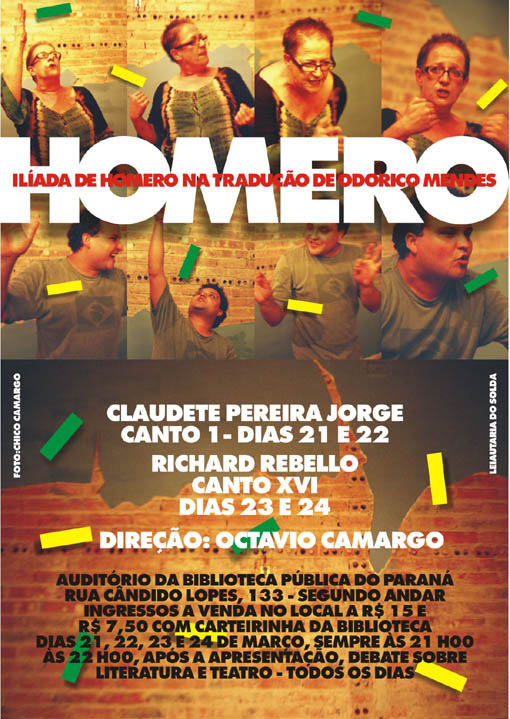
Homero na Bibioteca Pública do Paraná

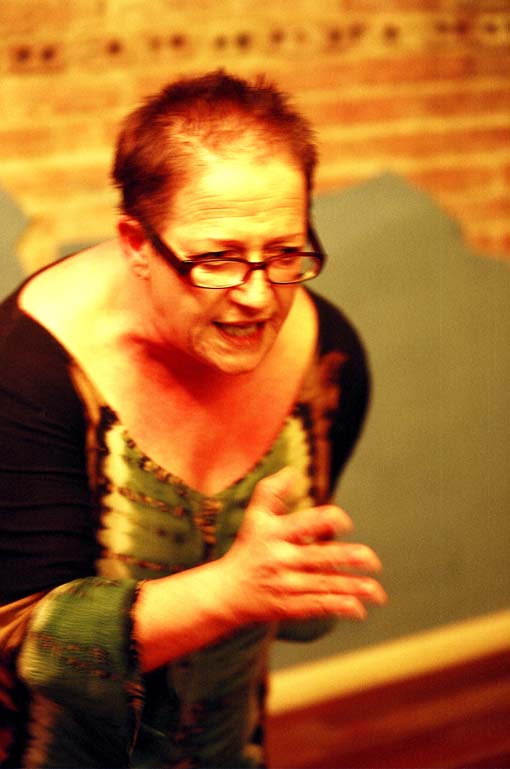
Claudete Pereira Jorge – canto I – 21 e 22 de março, í s 21h

“Febo, a tais preces, arco e aljava cruza,
Do vértice do céu baixa iracundo;
Vem semelhante í  noite, e a cada passo
Tinem-lhe ao ombro as frechas. Ante a frota
Suspenso, a farpa do carcás descaixa,
Terrí­vel o arco argênteo estala e zune:
Moles primeiramente a cães e mulos,
Depois com vira acerba ataca os homens,
De cadáveres sempre a arder fogueiras.
As tropas dias nove asseteadas,
Ao décimo as convida e ajunta Aquiles;
Inspiração da bracení­vea Juno,
Que seus Dânaos morrer cuidosa via.”

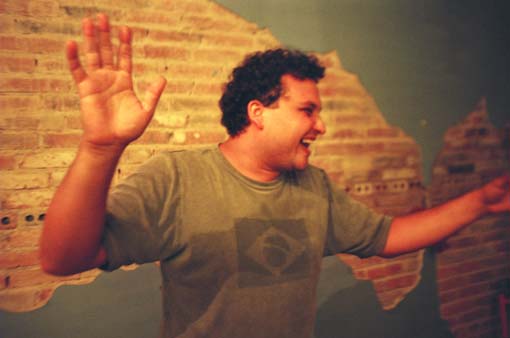
Richard Rebello – canto XVI – 23 e 24 de março, í s 21h

“Cinge o Menécio deslumbrante saio;
Com prata afivelando, as finas grevas
Ajusta í s pernas; estrelada e vária
Aos peitos liga a do veloz Pelides
Érea couraça; o claviargênteo gládio
Pendura; o grã pavês, sólido ombreia;
Põe í  forte cabeça o casco insigne,
De nutante penacho e horrente crista;
Válidas lanças a seu pulso adapta,
Que a do Eácida exí­mio, por disforme,
Argeu nenhum, só ele, manejava:”

Arte – Solda / fotos – Chico Camargo

“Cercam no e vozeiam como em curral na primavera moscas de alvos tarros de leite em roda zumbem”

Brandon should see this

reciclador-china
Photo by caro…
Some rights reserved

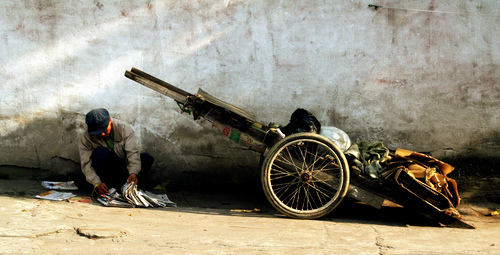
Para nadie es un secreto que China es un paí­s con “considerable” contaminación. Aún así­, es también un paí­s donde se recicla muuuuucho (yo no soy de términos estadisticos como podrán ver)…y todo ese reciclaje no lo hace la gente en sus casas, sino seí±ores como este, que van por la calle arrastrando una carreta, recogiendo botellas de plástico, cartones, bolsas y demás, que luego venden a las plantas de reciclaje. Para mi, este seí±or es un héroe.
_______________________

Itôs not a secret that China has got pollution problems. However, this is a country where a lot of recycling gets done. But unlike other countries, all that recycling is not done by the people at home, but by men like this one, that go around the cities, collecting plastic bottles, cardboard boxes, bags and anything the could sell to the Recycling Plants. In my opinion, this man is a hero“.